

In accordance with Article 13 of the Agreement on Common Principles and Rules of Technical Regulation in the Republic of Belarus, the Republic of Kazakhstan and the Russian Federation of 18 November 2010, the Customs Union Commission (hereinafter, the Commission) has decided:
1. To adopt the Technical Regulation of the Customs Union "On the Safety of Toys" (TR CU 008/2011) (attached).
2. To approve:
2.1. The list of international and regional (interstate) standards, or, in their absence, national (state) standards, the voluntary application of which ensures compliance with the requirements of the Technical Regulation of the Customs Union "On the Safety of Toys" (TR CU 008/2011) (attached);
Footnote. Item 2.1. as amended by Decision of the Board of the Eurasian Economic Commission No. 221 of 17.12.2019 (enters into force upon expiry of 30 calendar days from the date of its official publication).2.2. The list of international and regional (interstate) standards, or, in their absence, national (state) standards, containing the rules and methods of research (testing) and measurement, including the sampling rules, necessary for the application and fulfilment of the requirements of the Technical Regulation of the Customs Union "On the Safety of Toys" (TR CU 008/2011) and for the conformity assessment of objects of technical regulation (attached).
Footnote. Item 2.2 as amended by Decisions of the Board of the Eurasian Economic Commission No. 124 of 26.09.2017 (enters into force upon expiry of 30 calendar days from the date of its official publication); No. 221 of 17.12.2019 (enters into force upon expiry of 30 calendar days from the date of its official publication).3. To establish that:
3.1. The Technical Regulation of the Customs Union "On the Safety of Toys" (hereinafter, the Technical Regulation) enters into force on 1 July 2012;
3.2. Documents on the assessment (proof) of conformity with the mandatory requirements established by regulatory legal acts of the Customs Union or by the legislation of a Member State of the Customs Union, issued or adopted in respect of products that are objects of technical regulation of the Technical Regulation (hereinafter, products) before the day the Technical Regulation enters into force, shall remain valid until the end of their period of validity, but not later than 15 February 2014. The said documents issued or adopted before the day of official publication of this Decision shall remain valid until the end of their period of validity.
From the day the Technical Regulation enters into force, the issuance or adoption of documents on the assessment (proof) of conformity of products with the mandatory requirements previously established by regulatory legal acts of the Customs Union or by the legislation of a Member State of the Customs Union shall not be permitted;
3.3. Until 15 February 2014, the manufacture and placing on the market of products in accordance with the mandatory requirements previously established by regulatory legal acts of the Customs Union or by the legislation of a Member State of the Customs Union shall be permitted, provided that there are documents on the assessment (proof) of conformity of the products with the said mandatory requirements, issued or adopted before the day the Technical Regulation enters into force.
Such products shall be marked with the national conformity mark (market circulation mark) in accordance with Commission Decision No. 386 of 20 September 2010 or with the legislation of a Member State of the Customs Union.
Marking such products with the single mark of product circulation on the market of the Member States of the Customs Union shall not be permitted;
3.4. The circulation of products placed on the market during the period of validity of the documents on the assessment (proof) of conformity referred to in subitem 3.2 of this Decision shall be permitted during the shelf life (service life) of the products established in accordance with the legislation of a Member State of the Customs Union.
4. The Secretariat of the Commission, jointly with the Parties, shall prepare a draft Action Plan necessary for the implementation of the Technical Regulation and, within three months from the day this Decision enters into force, ensure its submission to the Commission for approval in the established procedure.
5. The Belarusian Party, with the participation of the Parties, shall, on the basis of monitoring the results of application of the standards, ensure the preparation of proposals for updating the lists of standards referred to in item 2 of this Decision and their submission to the Secretariat of the Commission, at least once a year from the day the Technical Regulation enters into force, for approval by the Commission in the established procedure.
Members of the Customs Union Commission: | |
For the Republic | For the Republic For the Russian |
of Belarus | of Kazakhstan Federation |
S. Rumas | U. Shukeyev I. Shuvalov |
APPROVED
by Decision of the Customs Union Commission
No. 798 of 23 September 2011
TECHNICAL REGULATION
OF THE CUSTOMS UNION
TR CU 008/2011
On Safety of Toys
Contents
Preface
Article 1. Scope of Application
Article 2. Definitions
Article 3. Rules of Circulation on the Market
Article 4. Safety Requirements
Article 5. Ensuring Compliance with Safety Requirements
Article 6. Conformity Confirmation
Article 7. Marking with the Single Mark of Product Circulation
on the Market of the Customs Union Member States
Article 8. Safeguard Clause
Annex 1 List of products that are not regarded as
toys and which are outside the scope of
the Technical Regulation of the Customs Union
"On Safety of Toys" (TR CU 008/2011)
Annex 2 Hygienic safety requirements for toys in
accordance with the Technical Regulation of the Customs
Union "On Safety of Toys" (TR CU 008/2011)
Annex 3 Requirements for information on hazards and for measures
to be taken when using toys
that present the greatest hazard, in
accordance with the Technical Regulation
of the Customs Union "On Safety of Toys"
(TR CU 008/2011)
Footnote. The Preface was deleted by Decision of the Council of the Eurasian Economic Commission of 26.01.2024 No. 5 (enters into force upon expiry of 180 calendar days from the date of its official publication).Footnote. Throughout the text, the words "Technical Regulation of the Customs Union" in the relevant grammatical case have been replaced with the words "Technical Regulation" in the relevant grammatical case in accordance with Decision of the Council of the Eurasian Economic Commission of 26.01.2024 No. 5 (enters into force upon expiry of 180 calendar days from the date of its official publication).
Article 1. Scope of Application
1. This Technical Regulation establishes safety requirements for toys that are mandatory for application and fulfilment in the customs territory of the Eurasian Economic Union (hereinafter – the Union).
Where other Technical Regulations of the Union (Customs Union) establishing safety requirements for toys have been adopted in respect of toys, such toys must comply with the requirements of all Technical Regulations of the Union (Customs Union) that apply to them.
This Technical Regulation applies to toys released into circulation in the customs territory of the Union.
2. This Technical Regulation does not apply to the products specified in Annex 1 to this Technical Regulation that are not regarded as toys, nor to toys made to individual order, exhibition samples, or toys that have previously been in use.
3. This Technical Regulation has been adopted for the purposes of protecting the life and health of children and of persons supervising them, and of preventing actions that mislead purchasers (consumers) of toys as to their purpose and safety.
Footnote. Article 1 as amended by Decision of the Council of the Eurasian Economic Commission of 26.01.2024 No. 5 (enters into force upon expiry of 180 calendar days from the date of its official publication).Article 2. Definitions
For the purposes of applying this Technical Regulation, the concepts used are those established by the Protocol on Technical Regulation within the Eurasian Economic Union (Annex No. 9 to the Treaty on the Eurasian Economic Union of 29 May 2014) and by the standard conformity assessment schemes approved by Decision of the Council of the Eurasian Economic Commission of 18 April 2018 No. 44, as well as the following concepts, which mean the following:
scented toy – a toy or part of a toy treated with a natural food flavoring;
trampoline for domestic use (trampoline) – a toy that bears the child's body weight and whose design allows jumping;
ignition - the onset of combustion under the effect of an ignition source, accompanied by a flame;
flammability - the ability of substances and materials to ignite;
play set containing chemical substances (not being a set for chemical experiments) - a set for making plaster casts; ceramic materials and vitrifying enamels supplied in sets for equipping miniature art workshops; sets containing modelling compounds based on plasticized polyvinyl chloride (with subsequent hardening in an oven); art casting sets; pouring sets; photo developing sets; adhesives, paints, varnishes, diluents and cleaners (solvents) supplied in construction kits;
play kit - a toy consisting of various objects, materials and substances, intended to develop children's creativity and manual skills;
toy - a product or material intended for play by a child (children) under 14 years of age;
activity toy – a toy intended for active recreation, whose supporting structure remains stationary during use and on which climbing, jumping, swinging, sliding, rolling, spinning, splashing, crawling or any combination of these actions can be performed;
aquatic toy - a toy (inflatable or non-inflatable) that bears the load of the child's body weight when swimming and (or) is intended for play in shallow water;
printed tabletop toy - a toy produced by printing methods, with or without the use of additional play elements;
magnetic toy – a toy whose design includes 1 or more magnets and (or) magnetic elements;
soft-stuffed toy - a toy, with or without a frame, with a soft surface and soft filling that allows a child to squeeze its main part easily by hand;
scale model toy - a toy whose dimensions are determined on a reduced scale relative to the actual dimensions of its prototype;
commercial name of a toy – a word or phrase that may supplement the name of the toy.
The commercial name of a toy need not reflect its consumer properties and must not replace the product name; it may also coincide with the manufacturer's trademark (for example, Baby Born doll "Magic Girl");
construction kit - a set of mechanical and (or) electrical (electronic) components intended for assembling various toys from it;
flying toy - a toy or part of a toy intended to be launched into free flight by means of an energy source (for example, compressed gas, a spring, electricity or inertial force) that continues to propel the object after the initial launch for a certain period or for the entire flight;
magnetic component of a toy - a part of a toy that includes an attached magnet or a fully or partially inserted magnet;
toy material - all materials that make up a toy;
set for making perfumery and cosmetic products - a toy intended to help a child acquire skills in making products such as soap, cream, shampoo, bath foam, lipstick, toothpaste, conditioner and other similar products;
set for developing taste skills (taste set) - a toy intended to help a child prepare dishes and drinks that include food ingredients such as flavouring substances, liquids and dry mixes;
board game for developing the sense of smell (set for developing the sense of smell) - a toy intended to help a child acquire skills in recognising various odours and aromatic compositions;
circulation of a toy on the market - the processes by which a toy passes from the manufacturer to the user (purchaser) in the customs territory of the Union, which the toy undergoes after its manufacture is completed;
optical toy - a toy whose operating principle is based on the principles of geometrical optics;
rattle - a toy intended for infants (under 1 year of age) that makes a sound when shaken and whose design allows it to be used while held in the hand by the child or by a person supervising the child;
user - a child using a toy for its intended purpose, and the person supervising the child;
purchaser (consumer) - a natural person or legal entity intending to purchase a toy or purchasing it;
intended use - use of a toy in accordance with its purpose as specified by the manufacturer on the toy and (or) in the operating documents;
child - a person under 14 years of age;
risk - a combination of the probability of harm and the consequences of that harm for the life and health of the child and of the person supervising the child;
typical sample - a product sample selected from a group of homogeneous toys (toys of one manufacturer, of one age group (for children under 3 years of age, or 3 years of age and older), of the same design type, with the same functions, manufactured according to one technical document from the same materials, and subject to the same safety requirements), having the largest set of functional characteristics (combining all design features of products of the same type) that ensure compliance with the established safety requirements;
sound recording playback device - a toy component intended to play back audio signals obtained by sound recording and contained on an analogue or digital medium or recorded in a specific file, the set of which can be changed by the user;
functional toy - a toy that is a model of an article or device used by adults, imitating its purpose and the performance of its functions;
functional magnet - a magnet intended for the operation of motors, relays, speakers and other electrical or electronic parts of a toy (where the magnetic properties are not among the play characteristics of the toy);
chemical toy - a set for children to carry out chemical experiments, consisting of one or more chemical substances and (or) reagents, supplied with or without equipment;
electric toy - a toy in which at least one function is performed by means of electrical energy.
electromechanical toy - a toy that uses an electric motor intended to drive component parts of the toy.
Footnote. Article 2 as amended by decisions of the Council of the Eurasian Economic Commission No. 12 of 17.03.2017 (enters into force 12 months after the date of its official publication); No. 5 of 26.01.2024 (enters into force 180 calendar days after the date of its official publication); No. 50 of 14.05.2024 (enters into force 180 calendar days after the date of its official publication).Article 3. Rules for Circulation on the Union Market
1. Toys shall be placed on the market in the customs territory of the Union provided that they have undergone the necessary conformity assessment procedures established by this Technical Regulation and by other Technical Regulations of the Union (Customs Union) that apply to them.
2. Toys whose conformity with the requirements of this Technical Regulation has not been confirmed shall not be marked with the single mark of product circulation on the Union market and shall not be permitted to be placed on the market in the customs territory of the Union.
Footnote. Article 3 as worded by Decision No. 5 of the Council of the Eurasian Economic Commission of 26.01.2024 (enters into force 180 calendar days after the date of its official publication).Article 4. Safety Requirements
1. A toy shall be designed and manufactured in such a way that, when used for its intended purpose, it does not pose a hazard to the life and health of children, and of persons supervising them, and ensures the absence of risk:
arising from the design of the toy;
arising from the materials used;
associated with the use of the toy, which cannot be eliminated by changing the design of the toy without changing its function and main characteristics, replacing the material.
The risk in using toys shall be commensurate with the age-related characteristics of children.
2. Materials
2.1. The materials from which toys are made shall be clean (free from contamination).
2.2. Toys intended for children under 3 years of age shall not use natural fur, natural leather, glass, porcelain, flocked materials (rubber, cardboard and paper), stuffing granules of 3 mm or less without an inner cover, or fillers of rattle-like toys whose size increases by more than 5% in a humid environment.
2.3. Toys shall not use secondary raw materials obtained by reprocessing used materials. The use of the manufacturer's own production waste is permitted for the production of toys.
2.4. In toys intended for children over 3 years of age, glass (which a child may touch fully or partially) may be used where it is:
functionally justified (for example, for optical toys, light bulbs, glass used in experiment sets);
glass fibre reinforcing a fabric, if it is a component of a polymer composite material;
articles made of solid glass in the form of balls or doll eyes.
2.5. The protective and decorative coating of toys shall be resistant to wet treatment and to the action of saliva and sweat.
The surface coating and painting of rattles, as well as of toy elements that, by their functional purpose, come into direct contact with the child's mouth (for example, the mouthpiece for blowing air in pipes, the opening and adjacent part for blowing air in inflatable balloons, etc.), shall be resistant to the action of saliva, sweat, wet treatment, hot water and abrasion.
3. Toys shall be designed and manufactured in such a way that, when used as intended, they do not pose a danger to the life and health of children or persons supervising them, and shall comply with the safety requirements of this Technical Regulation.
3.1. Organoleptic indicators
In terms of organoleptic indicators of hygienic safety, toys shall comply with the requirements established in Annex 2 to this Technical Regulation.
3.2. Physical and mechanical properties
3.2.1. A toy and its component parts, including fasteners, shall withstand the mechanical loads arising when the toy is used as intended. The toy shall not break or fold spontaneously when used as intended, and shall retain its consumer properties.
3.2.2. Accessible edges, sharp points, rigid parts, springs, fasteners, gaps, corners, projections, cords, ropes and fastenings of toys shall exclude the risk of injury to the child.
3.2.3. Leakage of liquid filling is not permitted in toys intended for children under 3 years of age or in toys that, by their functional purpose, come into direct contact with the child's mouth.
3.2.4. Moving component parts of a toy shall exclude the risk of injury to children. Drive mechanisms shall be inaccessible to the child.
3.2.5. A toy and detachable parts of a toy intended for children under 3 years of age, as well as toys attached directly to food products, shall have dimensions that prevent them from entering the respiratory tract.
3.2.6. The filling of soft-stuffed toys shall not contain hard or sharp foreign objects. The seams of soft-stuffed toys shall be strong. Soft-stuffed toys and their parts containing fibrous filling shall have a casing.
3.2.7. A toy placed inside food products and (or) supplied to retail trade together with a food product shall have its own packaging. The dimensions of such packaging shall not create a risk of suffocation of the child. External placement of an unpackaged toy on the packaging of a food product is permitted.
A toy placed inside food products and (or) supplied to retail trade together with a food product shall have dimensions that prevent it from entering the respiratory tract and (or) being swallowed, or shall be placed in primary packaging of dimensions that prevent it from entering the respiratory tract and (or) being swallowed.
3.2.8. A toy and its component parts shall minimise the risk associated with suffocation of the child and with obstruction of the intestinal tract.
3.2.9. Play masks and helmets made of airtight material that completely cover the child's head shall be designed and manufactured in such a way as to exclude the risk of suffocation due to insufficient ventilation.
3.2.10. A toy intended to keep the child's body afloat on the surface of water shall be designed and manufactured in such a way as to be airtight and strong.
3.2.11. A toy inside which a child can fit and which forms an enclosed space for the child shall have an exit opening that can easily be opened from the inside, and shall also have a surface with ventilation openings.
3.2.12. Toys that bear the child's body weight and are intended for riding shall be strong and stable (if a stable position is provided for by the operating conditions).
Toys that bear the child's body weight and are intended for riding, with a mechanical or electric drive unit, that have a freewheel mechanism or a neutral gear position shall have a braking mechanism. Toys in which motion is transmitted to the wheel directly by the child or via a mechanical transmission, and toys with an electric drive unit that have no freewheel mechanism, may be manufactured without braking mechanisms.
Toys with a chain drive shall be fitted with protective guards.
The supporting surfaces of toys that bear the child's body weight and are intended for riding shall have elements that prevent slipping.
3.2.13. Toys that bear the child's body weight and are not intended for riding, and toys for active recreation, shall be strong and resistant to tipping over, and shall not fold when used as intended.
3.2.14. Toys for active recreation and trampolines shall be designed and manufactured in such a way that moving elements, surfaces of protective elements, gaps, openings and slots do not create a danger of injury to the child.
3.2.15. A platform of a toy for active recreation intended for sitting or standing at a height of 1 000 mm or more above the level of the supporting surface shall exclude the risk of injury to the child.
3.2.16. Suspended swings shall be strong and shall not tip over; swing seats for children under 3 years of age shall have a design that prevents the child from falling.
3.2.17. Stationary floor toys weighing more than 4,5 kg that do not bear the child's body weight shall not tip over.
3.2.18. The design of a toy with a projectile released by means of a launching mechanism, as well as a projectile possessing kinetic energy, shall minimise the risk of injury to the child and (or) the person supervising the child.
3.2.19. The design of flying toys shall minimise the risk of eye injury.
3.2.20. Cords intended for a child to hold a kite and other similar toys, with a length of more than 2 m, shall be made of a material whose electrical resistivity shall be more than 100 MOhm/cm.
3.2.21. In construction sets and models for assembly by children under 10 years of age, soldering during assembly is not permitted.
3.2.22. A toy containing heating elements shall be manufactured in such a way as to ensure the following:
- the temperature of all surfaces accessible to contact shall not cause a burn on touching;
- liquids, vapours or gases contained in the toy which, when released (if such release is necessary for the functioning of the toy), may cause burns or other injuries shall not have elevated temperature or pressure values.
3.2.23. The intensity levels of the integral infrared radiation flux shall comply with the hygienic safety requirements established by Annex 2 to this Technical Regulation.
3.2.24. Local vibration levels in toys having a source of vibration shall comply with the hygienic safety requirements established by Annex 2 to this Technical Regulation.
3.2.25. Sound levels (sound pressure levels) in toys shall comply with the hygienic safety requirements established by Annex 2 to this Technical Regulation.
3.2.26. In printed board toys:
- text and pictures shall be clear and contrast with the main background;
- set-off of printing inks on paper and cardboard is not permitted.
3.2.27. An optical toy shall be designed and manufactured so as to minimise the risk associated with correction of the child's vision.
3.2.28. Toys using light-emitting diodes shall not have an adverse effect on the child's organs of vision.
3.2.29. The use of laser radiation systems of all types in toys is prohibited.
3.3. Flammability
Soft-stuffed toys, carnival costumes and carnival toy articles (for example, beards, moustaches, wigs, masks, crowns), as well as toys that a child can get inside, shall be fire-safe.
A play set containing chemical substances and not classified as a chemistry experiment set shall not contain substances or reagents which may ignite when mixed or form harmful vapours or gases.
A toy shall not be explosive or contain components (substances, materials) that become explosive when the toy is used.
A toy, including chemical toys, shall not contain substances or reagents which:
are capable of forming explosive mixtures as a result of a reaction when heated, and also when combined with oxidising substances;
are capable of forming flammable or explosive vapour-air mixtures.
3.4. Chemical Properties
3.4.1. When a toy is used, the risk of harm to health due to chemical substances coming into contact with the skin, mucous membranes, respiratory tract, eyes or stomach shall be minimised.
3.4.2. The sanitary-chemical indicators of toys shall comply with the hygienic safety requirements established by Annex 2 to this Technical Regulation.
3.4.3. In chemical toys and in play sets containing chemical substances and not classified as chemistry experiment sets, the use of a certain quantity of chemical substances or reagents is permitted if their content does not exceed the maximum permissible quantity established for each chemical substance in accordance with Annex 4 to this Technical Regulation.
3.4.4. Substances included in kits for making perfumery and cosmetic products shall be safe for the health of children and the persons supervising them, and the perfumery and cosmetic products obtained from such a kit shall comply with the requirements of the Technical Regulation of the Customs Union "On the Safety of Perfumery and Cosmetic Products" (TR CU 009/2011), adopted by Decision of the Customs Union Commission No. 799 of 23 September 2011.
3.4.5. In olfactory development sets and taste sets, food flavouring substances and food ingredients shall comply with the requirements of the Technical Regulation of the Customs Union "On Food Safety" (TR CU 021/2011), adopted by Decision of the Customs Union Commission No. 880 of 9 December 2011, and of the Technical Regulation of the Customs Union "Safety Requirements for Food Additives, Flavourings and Processing Aids" (TR CU 029/2012), adopted by Decision of the Council of the Eurasian Economic Commission No. 58 of 20 July 2012.
3.4.6. The use of substances prohibited for use in perfumery and cosmetic products under Annex 1 to the Customs Union Technical Regulation "On the Safety of Perfumery and Cosmetic Products" (TR CU 009/2011) shall not be permitted in sets for making perfumery and cosmetic products, sets for developing the sense of smell, taste sets and scented toys.
3.5. Toxicological and hygienic indicators
The toxicological and hygienic indicators of the hygienic safety of toys shall comply with the requirements established in Annex 2 to this Technical Regulation.
3.6. Electrical properties
3.6.1. The rated voltage in an electric toy and in its component parts shall not exceed 24 V.
3.6.2. A charger and a transformer intended to power mains-operated toys shall not form an integral part of the toy and shall be detachable from it.
3.6.3. Toy parts that are in contact with, or can come into contact with, a source of electrical energy, as well as cables and wires, shall be insulated and mechanically protected to eliminate the risk of electric shock.
3.6.4. The electrostatic field strength level at the surface of toys shall comply with the hygienic safety requirements established by Annex 2 to this Technical Regulation.
3.6.5. The electromagnetic field strength level generated by electric and electromechanical toys shall comply with the hygienic safety requirements established by Annex 2 to this Technical Regulation.
3.6.6. The power-frequency (50 Hz) electric field strength level of toys powered from an alternating-current mains supply at power frequency (50 Hz) shall comply with the hygienic safety requirements established by Annex 2 to this Technical Regulation.
3.7. Radiation safety
The radiation safety indicators (specific effective activity of natural radionuclides) of toys made from natural materials shall comply with the hygienic safety requirements established in Annex 2 to this Technical Regulation.
3.8. Microbiological indicators
The microbiological indicators of the hygienic safety of toys shall comply with the requirements established in Annex 2 to this Technical Regulation.
3.9. Magnetic properties
3.9.1. Loose magnets and magnetic components of toys shall have a calculated magnetic flux index of less than 0,5 T2 mm2 or dimensions that prevent them from entering the respiratory tract and from being swallowed.
3.9.2. For toys intended for children under 3 years of age that contain magnets or magnetic components, in addition to the requirements of subclause 3.9.1 of this Technical Regulation, detachment of magnets or magnetic components with a magnetic flux index of less than 0,5 T2 mm2 is not permitted if the detached magnets have dimensions that do not prevent them from entering the respiratory tract and from being swallowed.
4. Packaging
Packaging shall be safe and shall eliminate the risk of the child suffocating.
A toy shall have consumer and(or) group packaging.
If the packaging in which a toy is sold is also intended to be used (has a play function), it is regarded as a component part of the toy. The scope of application of the packaging is determined by the manufacturer.
The consumer packaging of sets for making perfumery and cosmetic products, play sets for developing the sense of smell and taste sets shall ensure the safety and preservation of the components of these sets throughout their shelf life.
5. Labelling
5.1. The labelling of toys shall be accurate, clear, easily legible, and accessible for inspection and identification. The information specified in subclause 5.3 of this Technical Regulation and in Annex 3 to this Technical Regulation shall be accessible without breaking the integrity of (damaging) the packaging.
5.2. Labelling is applied by the following parties: the manufacturer (person authorized by the manufacturer), the importer (seller). The place and method of applying the labelling are determined by the following parties: the manufacturer (person authorized by the manufacturer), the importer (seller).
5.3. The labelling shall contain the following information:
- name of the toy;
- commercial name of the toy (if any);
- information on the toy that ensures its identification (type, model, article number and (or) another identifying feature that makes it possible to classify the product as a toy, to characterize it accurately and to distinguish it from another toy) (if any);
- name of the country of manufacture (if the country where the toy is produced does not coincide with the address of the manufacturer's location);
- name and location of the manufacturer (person authorized by the manufacturer) and importer (seller), and their contact information;
- manufacturer's trademark (if any);
- minimum age of the child for whom the toy is intended and (or) a pictogram indicating the child's age;
- main structural material (for children under 3 years of age) (if necessary);
- flavouring (if any);
- toy care instructions (if necessary);
- date of manufacture (month, year);
- batch code (if any);
- service life or shelf life (where established);
- storage conditions (if necessary).
Letters of the Latin alphabet may be used when the labelling states the commercial name, the manufacturer's location (except for the country of origin), the manufacturer's trademark, and the information on the toy that ensures its identification.
The labelling of a set for making perfumery and cosmetic products shall contain information on its composition (the generic name, proper name (if any) and quantity of the components). Each component of the set shall have a generic name and a proper name (if any). The list of ingredients is established in accordance with clause 9 of Article 5 of the Customs Union Technical Regulation "On the Safety of Perfumery and Cosmetic Products" (TR CU 009/2011).
5.4. Depending on the type of toy, the labelling includes the list of contents (for play sets), rules for using the toy, cleaning methods, safety measures for handling the toy, warning information and assembly instructions.
The warning information shall indicate special precautions to be taken during use in accordance with Annex 3 to this Technical Regulation.
6. The marking and the technical documentation supplied with the toy shall be in Russian and in the state language(s) of the Member State of the Union where the relevant requirements are set out in the legislation(s) of the Member State(s) of the Union.
Footnote. Article 4 as amended by the decision of the Council of the Eurasian Economic Commission of 17.03.2017 No. 12 (enters into force upon expiry of 12 months from the date of its official publication); of 26.01.2024 No. 5 (enters into force upon expiry of 180 calendar days from the date of its official publication); of 14.05.2024 No. 50 (enters into force upon expiry of 180 calendar days from the date of its official publication).Article 5. Ensuring Compliance with Safety Requirements
1. Compliance of toys with the requirements of this Technical Regulation is ensured by fulfilling:
1.1. the hygienic safety requirements established in Annex 2 to this Technical Regulation;
1.2. the safety requirements established by this Technical Regulation (except for those specified in subparagraph 1.1 of this paragraph) directly, or the requirements of the standards included in the list of international and regional (interstate) standards or, in their absence, national (state) standards, whose voluntary application ensures compliance with the requirements of this Technical Regulation (hereinafter – the list of standards applied on a voluntary basis).
2. The methods of research (testing) and measurement of toys are established in the standards included in the list of international and regional (interstate) standards or, in their absence, national (state) standards containing the rules and methods of research (testing) and measurement, including sampling rules, required for applying and fulfilling the requirements of this Technical Regulation and for carrying out conformity assessment of toys (hereinafter – the list of standards containing rules and methods).
Footnote. Article 5 as worded by the decision of the Council of the Eurasian Economic Commission of 26.01.2024 No. 5 (enters into force upon expiry of 180 calendar days from the date of its official publication).Article 6. Conformity Assessment
1. Before being placed on the market in the customs territory of the Union, toys shall undergo conformity assessment against the requirements of this Technical Regulation in the form of proof of conformity.
Proof of conformity of toys with the requirements of this Technical Regulation is carried out in accordance with the standard conformity assessment schemes approved by Decision of the Council of the Eurasian Economic Commission of 18 April 2018 No. 44, taking into account the specifics established by this Technical Regulation.
2. Proof of conformity of toys takes the form of certification.
Certification is carried out by a product certification body included in the unified register of conformity assessment bodies of the Union (hereinafter – the product certification body) under certification schemes 1с and 3с.
Research (testing) and measurement of toys for certification purposes are carried out by an accredited testing laboratory (centre) included in the unified register of conformity assessment bodies of the Union (hereinafter – the accredited testing laboratory (centre)).
When research (testing) and measurement of toys are carried out, photo and (or) video recording of the process and results of the research (testing) and measurement is performed in the cases, in the manner and to the extent established by the relevant standards included in the list of standards containing rules and methods.
3. In the certification of toys, the applicant is a legal entity registered in the territory of a Member State of the Union in accordance with its legislation, or a natural person registered as an individual entrepreneur in that territory in accordance with that legislation, and is:
for serially manufactured products (scheme 1с) – the manufacturer (the person authorised by the manufacturer);
for a batch of products (scheme 3с) – the manufacturer (the person authorised by the manufacturer), the seller (importer).
4. When carrying out certification of toys:
4.1. the applicant, together with the application for certification work (hereinafter – the application), submits the following documents and information to the product certification body:
a) for serially manufactured toys:
a copy of the technical documentation (design, and (or) engineering, and (or) process, and (or) operational) for the toys and (or) type samples of the toys;
a copy of the document (documents) in accordance with which the toys are manufactured (standard, organisation standard, technical specifications or other document) (if any);
a copy of the document on registration of the trademark (brand) or of the agreement (licence agreement) on the right to use the trademark (brand) (if any);
a colour image of the sample (type sample) of the toy;
a list of standards (indicating their designations and titles, as well as sections (clauses, subclauses), if compliance with the requirements of this Technical Regulation can be ensured by applying individual sections (clauses, subclauses) of these standards rather than the standards as a whole) included in the list of standards applied on a voluntary basis (if applied by the applicant);
a description of the technical solutions adopted and of the results of the risk assessment confirming fulfilment of the requirements of this Technical Regulation, if standards included in the list of standards applied on a voluntary basis have not been applied or do not exist (where necessary);
a copy of the certificate of conformity of the quality management system covering the production of toys, confirming conformity of the quality management system implemented by the manufacturer with the requirements of the relevant standard (if any) and issued by a certification body for quality management systems;
copies of documents on conformity assessment of the raw materials, materials and components of the toys (if any);
information on the raw materials, materials and components, information on their manufacturers (if any);
a copy of the contract with the manufacturer (including a foreign manufacturer) providing for ensuring the conformity of toys supplied to the customs territory of the Union with the requirements of this Technical Regulation and liability for non-conformity of such toys with those requirements (for the person authorised by the manufacturer);
information on the registration or record (individual, identification) number of the applicant assigned upon state registration of a legal entity or of an individual as an individual entrepreneur in accordance with the legislation of the Member States of the Union;
other documents, at the applicant's discretion, submitted as evidence of the conformity of the toys with the requirements of this Technical Regulation (if any);
b) for a batch of toys:
a copy of the technical documentation (design, and (or) engineering, and (or) process, and (or) operational) for the toys and (or) type samples of the toys (if any);
a copy of the document on registration of the trademark (brand name) or of the agreement (licence agreement) on the right to use the trademark (brand name) (if any);
a copy of the document (documents) in accordance with which the toys are manufactured (standard, company standard, technical specifications or other document) (if any);
a colour image of the sample (type sample) of the toy;
a copy of the contract (supply agreement) and shipping documents identifying the batch of toys, including its size;
a list of standards (indicating their designations and titles, as well as sections (clauses, subclauses), if compliance with the requirements of this Technical Regulation can be ensured by applying individual sections (clauses, subclauses) of these standards rather than the standards as a whole) included in the list of standards applied on a voluntary basis (if applied by the applicant);
a description of the technical solutions adopted and of the results of the risk assessment confirming fulfilment of the requirements of this Technical Regulation, if the standards included in the list of standards applied on a voluntary basis have not been applied or do not exist (if necessary);
information on the materials and components from which the toys are made (if any);
information on the registration or record (individual, identification) number of the applicant assigned upon state registration of a legal entity or of an individual as an individual entrepreneur in accordance with the legislation of the Member States of the Union;
other documents, at the applicant's discretion, submitted as evidence of the conformity of the toys with the requirements of this Technical Regulation (if any);
4.2. the manufacturer (for scheme 1c):
takes all necessary measures to ensure the stability of the production process and the conformity of the manufactured toys with the requirements of this Technical Regulation, and performs production control;
takes all necessary measures to ensure the stable functioning of the implemented and certified quality management system (if any);
4.3. the applicant, depending on the certification scheme applied:
submits to the product certification body an application together with the documents and information specified in subclause 4.1 of this clause;
after the product certification body has decided to carry out certification, concludes a contract for certification or for certification, research (testing) and measurements (if no contract has been concluded previously);
after receiving the certificate of conformity of the toys with the requirements of this Technical Regulation (hereinafter, the certificate of conformity), ensures that the toys are marked with the single mark of product circulation on the Union market in the manner approved by the Eurasian Economic Commission;
compiles and keeps a set of evidentiary materials confirming the conformity of the toys with the requirements of this Technical Regulation, which includes:
the documents and information provided for in subclause 4.1 of this clause;
the report (reports) on identification and (or) sampling of samples (type samples) of the toys;
the report (reports) on research (testing) and measurements of the toys confirming the conformity of the toys with the requirements of this Technical Regulation;
the report on the results of the analysis of the state of production (scheme 1c);
the certificate of conformity;
4.4. the product certification body:
reviews and analyses the application and the attached documents, decides whether to carry out certification and informs the applicant of its decision in writing;
carries out identification and sampling of samples (type samples) of the toys for research (testing) and measurements of the toys;
determines, on the basis of the safety requirements in accordance with this Technical Regulation, the specific safety requirements for the toys being certified;
analyses the technical solutions adopted and the results of the risk assessment confirming fulfilment of the requirements of this Technical Regulation, carried out by the manufacturer, and determines the methods of research (testing) and measurements of the toys from the list of standards containing rules and methods (where standards from the list of standards applied on a voluntary basis are not applied);
on a contractual basis (if necessary), engages an accredited testing laboratory (centre) from among those with which it cooperates to carry out research (testing) and measurements of the selected samples (type samples) of the toys;
analyses the state of production and draws up a report on the results of the analysis of the state of production (scheme 1c). If the manufacturer has a certified quality management system for the production of toys, the product certification body may, with respect to the items inspected during the analysis of the state of production, review the quality management system documents relating to the production of the toys being certified;
consolidates the results of the analysis of the documents and information submitted by the applicant in accordance with subclause 4.1 of this clause, the results of research (testing) and measurements of samples (type samples) of the toys (schemes 1c, 3c) and the results of the analysis of the state of production (scheme 1c);
if the results of the analysis of the documents submitted by the applicant, of research (testing) and measurements of samples (type samples) of the toys (schemes 1c, 3c) and of the analysis of the state of production (scheme 1c) are positive, decides to issue the certificate of conformity, draws up the certificate of conformity and issues it to the applicant;
enters information on the issued certificate of conformity into the unified register of issued certificates of conformity and registered declarations of conformity;
compiles and keeps a set of evidentiary materials confirming the conformity of the toys with the requirements of this Technical Regulation, as specified in subclause 4.3 of this clause;
in the event of negative results of the analysis of the documents submitted by the applicant, of the results of research (tests) and measurements of samples (type samples) of toys and of the analysis of the state of production (scheme 1с), sends the applicant a reasoned decision refusing to issue the certificate of conformity.
For the application of scheme 3с, the results of research (tests) and measurements of samples (type samples) of toys may be used for subsequent batches of similar products. In this case, the product certification body carries out identification of the batch of toys to establish its similarity to the products for which a certificate of conformity was previously issued. If the product certification body establishes that the batch of toys is similar to the products for which a certificate of conformity was previously issued, the selection of samples (type samples) of toys from the batch, as well as research (tests) and measurements of the toys, are not carried out. The validity period of the research (test) and measurement report for toys that is used shall be not more than 1 year from the date of its approval.
5. The set of documents and information specified in subparagraph 4.1 of this paragraph shall be compiled and submitted on paper or electronic media.
6. Identification of toys shall be carried out by the product certification body that received the application.
6.1. The following methods are used to identify toys:
documentary. When toys are identified by documentation, it is determined whether the characteristics of the product stated in the application, in the documentation submitted by the applicant in accordance with subparagraph 4.1 of paragraph 4 of this Article, and on the marking (label (label sample)) are identical to the essential features established by this Technical Regulation and by standards included in the list of standards applied on a voluntary basis;
visual. When the visual method of identifying toys is used, it is established whether the characteristics of the toys that can be determined by visual inspection are identical to the essential features established by this Technical Regulation, by standards included in the list of standards applied on a voluntary basis, and by the technical documentation for the toys.
Where necessary, an instrumental (analytical) identification method is used, which provides for testing of toys in accordance with the methods of research (testing) and measurement of toys established by standards included in the list of standards containing rules and methods.
6.2. When identifying toys, the product certification body analyses the documents characterizing the toys and specified in subparagraph 4.1 of paragraph 4 of this Article, as well as the application.
Where it is necessary to apply the instrumental (analytical) method to identify toys, the product certification body arranges identification tests.
When carrying out identification, the product certification body establishes whether the characteristics of the toys submitted for certification are identical to the features established by this Technical Regulation, using the documents submitted by the applicant, by applying one or more of the identification methods specified in subparagraph 6.1 of this paragraph, including with the involvement of accredited testing laboratories (centres).
The results of identification may be presented in the relevant report (act).
7. The certificate of conformity shall be drawn up according to the uniform form and rules approved by the Eurasian Economic Commission.
8. The product certification body carries out periodic assessment of certified toys (scheme 1с) during the validity period of the certificate of conformity 1 time per year by means of research (tests) and measurements of type samples of toys in an accredited testing laboratory (centre) and (or) by means of analysis of the state of production.
In the event of negative results of the periodic assessment of certified toys, the product certification body takes one of the following decisions:
to suspend the certificate of conformity;
to terminate the certificate of conformity.
The decision taken by the product certification body is documented and communicated to the applicant.
The product certification body enters information on the suspension or termination of the certificate of conformity into the unified register of issued certificates of conformity and registered declarations of conformity.
9. If changes are made to the design of the toys (including the materials used) or to their production technology that may affect the conformity of the products with the requirements of this technical regulation, the applicant shall notify the product certification body that issued the certificate of conformity in writing before such changes are made. That body shall decide whether additional research (tests) and measurements of samples (type samples) of the toys and (or) an analysis of the state of production (scheme 1c) are necessary.
10. The validity period of the certificate of conformity shall be:
for serially produced toys – not more than 5 years;
for a batch of toys, no validity period is established for the certificate of conformity.
11. The period for which the applicant shall keep the certificate of conformity and the set of evidentiary materials shall be:
for serially produced toys – not less than 10 years from the date on which production of such toys ceased;
for a batch of toys – not less than 10 years from the date of sale of the last item of the batch.
The period for which the product certification body shall keep the certificate of conformity and the set of evidentiary materials shall be:
not less than 5 years from the date of expiry of the certificate of conformity, if its validity period is limited;
not less than 10 years from the date of registration of the certificate of conformity, if its validity period is not limited.
The application and copies of the registered certificate of conformity and of the set of evidentiary materials may be stored in electronic form in accordance with the legislation of the Member States of the Union.
12. Documents drawn up in a foreign language and included in the set of evidentiary materials shall be accompanied by a translation into Russian and (or), where the legislation of a Member State of the Union so requires, into the state language of the Member State of the Union in which the certification of the toys is carried out.
Footnote. Article 6 as worded by Decision of the Council of the Eurasian Economic Commission No. 5 of 26.01.2024 (enters into force upon expiry of 180 calendar days from the date of its official publication).Article 7. Marking with the Single Mark of Product Circulation on the Union Market
1. Toys that meet the safety requirements of this technical regulation and have undergone conformity assessment in accordance with Article 6 of this technical regulation shall be marked with the single mark of product circulation on the Union market.
2. Marking with the single mark of product circulation on the Union market shall be carried out before the toys are placed on the market.
3. The single mark of product circulation on the Union market shall be applied directly to the toy itself and(or) to the packaging of the toy (consumer, group, transport) and (or) to the label, medallion, tag (including a sewn-in tag), leaflet inserts, and shall also be shown in the operating documents accompanying it.
The single mark of product circulation on the Union market shall be applied by any method that ensures a clear and distinct image throughout the entire service life of the toy.
For toys consisting of several parts, the single mark of product circulation on the Union market shall be applied to those parts that may be placed on the market separately.
4. Toys shall be marked with the single mark of product circulation on the Union market if they conform to the requirements of all technical regulations of the Union (Customs Union) that apply to them and that provide for the application of the single mark of product circulation on the Union market.
Footnote. Article 7 as amended by Decisions of the Council of the Eurasian Economic Commission No. 12 of 17.03.2017 (enters into force upon expiry of 12 months from the date of its official publication); No. 5 of 26.01.2024 (enters into force upon expiry of 180 calendar days from the date of its official publication).Article 8. Safeguard Clause
Footnote. Article 8 was repealed by Decision of the Council of the Eurasian Economic Commission No. 5 of 26.01.2024 (enters into force upon expiry of 180 calendar days from the date of its official publication).
Annex 1
to the Technical Regulation
of the Customs Union
"On Safety of Toys"
(TR CU 008/2011)
LIST
of products that are not considered toys and to which the Technical Regulation of the Customs Union "On Safety of Toys" (TR CU 008/2011) does not apply
Footnote. Annex 1 as worded by Decision of the Council of the Eurasian Economic Commission No. 50 of 14.05.2024 (enters into force upon expiry of 180 calendar days from the date of its official publication).
1. Christmas tree decorations, artificial Christmas trees and accessories for them, electric garlands, decorative articles intended for holidays and festive events (for example, noses, party hats).
2. Scale models for collecting (for example, exact scale models of cars, boats, trains, historical miniatures such as tin soldiers).
3. Equipment for children's playgrounds.
4. Sports equipment, including roller skates, inline skates, skateboards, intended for sports activities of children with a body weight of more than 20 kg.
5. Scooters and other means of transport for children with a body weight of more than 50 kg (including electric ones), intended for sports activities or for travel on public roads and sidewalks.
6. Folk and decorative dolls.
7. Toys installed in public places for general use, costumes for animators (for example, full-size costume characters).
8. Gaming machines.
9. Puzzles containing more than 500 pieces.
10. Pneumatic weapons (rifles and pistols using compressed gas, with the exception of water rifles and water pistols), exact replicas of firearms.
11. Catapults, crossbows, slingshots and throwing devices (except those intended by the manufacturer for children as a toy).
12. Articles and games using throwing projectiles such as darts with metal tips.
13. Transformers for mains-powered toys, chargers for rechargeable batteries, including those supplied together with a toy.
14. Articles intended for use in the educational process under adult supervision in schools and other educational institutions, including those containing electrical and (or) heating elements (for example, an electric kettle, an iron, a cooker).
15. Vehicles with an internal combustion engine.
16. Toy machines with a steam engine.
17. Bicycles with a maximum saddle height of 435 mm or more.
18. Games and toys operating at a rated voltage exceeding 24 V.
19. Costume jewellery for children (except for jewellery defined by the manufacturer as a toy, as well as play sets for making jewellery).
20. Equipment for underwater swimming, swimming training aids (for example, fins, boards, swimming paddles, snorkels, swimming masks, inflatable armbands, inflatable life-saving devices).
21. Protective equipment (for example, swimming goggles, sunglasses, bicycle helmets, skateboard helmets, knee pads, elbow pads).
22. Flying toys with rotor blades rotating in an approximately horizontal plane, with a blade length of more than 175 mm when measured from the centre of rotation to the tip edge and a total mass of the flying toy of more than 50 g.
23. Archery bows whose length in the untensioned state exceeds 1200 mm.
24. Sanitary and hygiene articles made of latex, rubber, silicone elastomers and plastics for children.
25. Fireworks, party poppers, percussion caps, confetti, detonators that are not specifically intended for toys.
26. Electronic equipment, such as personal computers and game consoles, used to access interactive software and associated peripheral equipment, with the exception of electronic equipment or associated peripheral equipment that is specifically intended for use by children and has play value in its own right (for example, specially designed personal computers, keyboards, joysticks or steering wheels).
27. Interactive software intended for leisure and entertainment (for example, computer games and electronic storage media (compact disc, flash memory)).
28. Souvenir products (articles intended to satisfy a person's aesthetic needs and not intended for a child's play).
29. Creative kits whose marking does not contain information on the minimum age of the child for whom they are intended, or a pictogram indicating the child's age.
30. Kits for growing plants and living creatures (for example, ants).
Annex 2
to the Technical Regulation
of the Customs Union
"On Safety of Toys"
(TR CU 008/2011)
Hygienic Safety Requirements for Toys in Accordance
with the Technical Regulation of the Customs Union
"On the Safety of Toys"
(TR CU 008/2011)
Footnote. Annex 2 as amended by Decision of the Council of the Eurasian Economic Commission No. 50 of 14.05.2024 (enters into force upon expiry of 180 calendar days from the date of its official publication).
1. The hygienic safety requirements for toys include:
organoleptic indicators (odour, taste);
physical factors (sound level, electrostatic field strength level, radio-frequency electromagnetic field strength level, electric field strength level, intensity level of the integral infrared radiation flux, local vibration level, specific effective activity of natural radionuclides);
sanitary-chemical indicators (migration into model media of harmful chemical substances, the list of which is determined by the chemical composition of the material, and the limits for the release of harmful chemical substances from toys);
toxicological-hygienic indicators (irritant effect on mucous membranes, toxicity index);
microbiological indicators.
If, in the course of confirming hygienic safety, a toy is found not to comply with any of the monitored indicators, it shall be deemed non-compliant, and further testing shall be discontinued.
2. Organoleptic indicators
2.1. The odour intensity of a toy under natural conditions and in an aqueous extract shall not exceed 1 point for toys intended for children under 1 year of age, and 2 points for children over 1 year of age.
The odour intensity of the sample and of the aqueous extract of toys for children over 3 years of age shall not exceed 2 points. This requirement does not apply to scented toys, board games for developing the sense of smell, kits for making perfumery and cosmetic products, or kits for developing taste skills.
2.2. Toys intended for children under 3 years of age, and toys that come into contact with the oral cavity, shall not have a taste with an intensity of more than 1 point.
3. Physical factors
3.1. The equivalent sound level (sound pressure level) of toys (except for toys emitting impulse sound, toy modules for sports competitions, devices for playing back sound recordings, tuned musical toys, wind toys, percussion toys (including rattles), and squeaker-type toys) shall be:
for children under 3 years of age – not more than 60 dBA;
for children aged from 3 to 6 years – not more than 65 dBA;
for children over 6 years of age – not more than 70 dBA;
for outdoor play – not more than 75 dBA.
The maximum sound level (sound pressure level) of toys (except for toys emitting impulse sound, toy modules for sports competitions, devices for playing back sound recordings, tuned musical toys, wind toys, percussion toys (including rattles), and squeaker-type toys) shall be:
for children under 3 years of age – not more than 70 dBA;
for children aged from 3 to 6 years – not more than 75 dBA;
for children over 6 years of age – not more than 80 dBA;
for outdoor play – not more than 85 dBA.
The maximum sound level (sound pressure level) of toys emitting impulse sound as an element of play (a strike, a single shot and the like) shall be not more than 90 dBA.
3.2. The electrostatic field strength level on the surface of toys made of polymer and polymer-containing materials, textile and blended textile materials shall not exceed 15 kV/m.
The electrostatic field strength on the surface of toys of small linear dimensions (which do not allow measurements to be taken according to the test method) is not tested.
3.3. The strength level of the electromagnetic field emitted by electric and electromechanical toys shall not exceed:
25 V/m in the frequency range 0,3 – 300 kHz;
15 V/m in the frequency range 0,3 – 3 MHz;
10 V/m in the frequency range 3 – 30 MHz;
3 V/m in the frequency range 30 – 300 MHz.
The power flux density of the electromagnetic field emitted by electric and electromechanical toys in the frequency range 0,3 – 300 GHz shall not exceed 10 microwatts/cm2.
3.4. The electric field strength level at power frequency (50 Hz) of toys powered from an alternating current mains supply at power frequency (50 Hz) shall not exceed 0,5 kV/m.
3.5. The intensity level of the integral infrared radiation flux shall not exceed 100 W/m2.
3.6. Local vibration levels in toys that have a source of vibration shall not exceed 63 dB at octave-band geometric mean frequencies of 8 Hz and 16 Hz, 69 dB at 31,5 Hz, 75 dB at 63 Hz, 81 dB at 125 Hz, 87 dB at 250 Hz, 93 dB at 500 Hz, and 99 dB at 1000 Hz. The frequency-weighted vibration acceleration level shall not exceed 66 dB.
3.7. The specific effective activity of natural radionuclides in natural mineral-based materials (for example, sand, clay, ceramics, gypsum and other similar materials) and in products made from them shall not exceed 370 Bq/kg; the specific activity of caesium-137 in wood materials and wooden products shall not exceed 300 Bq/kg.
4. Sanitary-chemical indicators
4.1. The level of migration of harmful chemical substances from toys into the model medium (aqueous, air) shall not exceed the limits specified in Table 1.
Table 1
Sanitary-chemical indicators applicable to toys
Footnote. Table 1 as amended by Decision of the Council of the Eurasian Economic Commission No. 12 of 17.03.2017 (enters into force upon expiry of 12 months from the date of its official publication).Name of materials, articles | Name of the harmful substance determined | Migration level | |
aqueous medium (mg/dm3), not more than | air medium (mg/m3), not more than | ||
Polystyrene | acrylonitrile | 0,02 | 0,03 |
acetaldehyde | 0,2 | 0,01 | |
acetone | 0,1 | 0,35 | |
benzaldehyde | 0,003 | 0,04 | |
benzene | 0,01 | 0,1 | |
xylenes (mixture of isomers) | 0,05 | 0,2 | |
cumene (isopropylbenzene) | 0,1 | 0,014 | |
methyl methacrylate | 0,25 | 0,01 | |
alcohols: | |||
methyl | 0,2 | 0,5 | |
butyl | 0,5 | 0,1 | |
styrene | 0,01 | 0,002 | |
toluene | 0,5 | 0,6 | |
formaldehyde | 0,1 | 0,003* | |
ethylbenzene | 0,01 | 0,02 | |
Styrene copolymers | |||
Acrylonitrile-butadiene-styrene plastics (ABS plastics) | alpha-methylstyrene | 0,1 | 0,04 |
acrylonitrile | 0,02 | 0,03 | |
styrene | 0,01 | 0,002 | |
benzaldehyde | 0,003 | 0,04 | |
benzene | 0,01 | 0,1 | |
xylenes (mixture of isomers) | 0,05 | 0,2 | |
styrene | 0,01 | 0,002 | |
toluene | 0,5 | 0,6 | |
ethylbenzene | 0,01 | 0,02 | |
Polystyrene, bulk-polymerised, high-impact | styrene | 0,01 | 0,002 |
alcohols: | |||
methyl | 0,2 | 0,5 | |
butyl | 0,5 | 0,1 | |
formaldehyde | 0,1 | 0,003* | |
benzene | 0,01 | 0,1 | |
toluene | 0,5 | 0,6 | |
ethylbenzene | 0,01 | 0,02 | |
Styrene-acrylonitrile copolymer | styrene | 0,01 | 0,002 |
acrylonitrile | 0,02 | 0,03 | |
formaldehyde | 0,1 | 0,003* | |
benzaldehyde | 0,003 | 0,04 | |
Styrene-methyl methacrylate copolymer | styrene | 0,01 | 0,002 |
methyl methacrylate | 0,25 | 0,01 | |
methyl alcohol | 0,2 | 0,5 | |
formaldehyde | 0,1 | 0,003 | |
styrene | 0,01 | 0,002 | |
Styrene-methyl methacrylate-acrylonitrile copolymer | styrene | 0,01 | 0,002 |
methyl methacrylate | 0,25 | 0,01 | |
acrylonitrile | 0,02 | 0,03 | |
methyl alcohol | 0,2 | 0,5 | |
formaldehyde | 0,1 | 0,003* | |
Copolymers | styrene | 0,01 | 0,002 |
butadiene | 0,05 | 1,0 | |
acetaldehyde | 0,2 | 0,01 | |
acetone | 0,1 | 0,35 | |
alcohols: | |||
methyl | 0,2 | 0,5 | |
butyl | 0,5 | 0,1 | |
xylenes (mixture of isomers) | 0,05 | 0,2 | |
Expanded polystyrenes | styrene | 0,01 | 0,002 |
benzene | 0,01 | 0,1 | |
toluene | 0,5 | 0,6 | |
ethylbenzene | 0,01 | 0,02 | |
cumene (isopropylbenzene) | 0,1 | 0,014 | |
methyl alcohol | 0,2 | 0,5 | |
formaldehyde | 0,1 | 0,003* | |
Polyolefin-based materials | acetaldehyde | 0,2 | 0,01 |
acetone | 0,1 | 0,35 | |
hexane | 0,1 | - | |
hexene | - | 0,085 | |
heptane | 0,1 | - | |
heptene | - | 0,065 | |
isopropyl alcohol | 0,1 | 0,6 | |
butyl alcohol | 0,5 | 0,1 | |
isobutyl alcohol | 0,5 | 0,1 | |
methyl alcohol | 0,2 | 0,5 | |
propyl alcohol | 0,1 | 0,3 | |
formaldehyde | 0,1 | 0,003* | |
ethyl acetate | 0,1 | 0,1 | |
Name of |
Name of the | Migration level | |
aqueous medium |
air medium | ||
Vinyl acetate-based polymers | acetaldehyde | 0,2 | 0,01 |
vinyl acetate | 0,2 | 0,15 | |
hexane | 0,1 | - | |
heptane | 0,1 | - | |
formaldehyde | 0,1 | 0,003* | |
Polyvinyl chlorides | acetaldehyde | 0,2 | 0,01 |
acetone | 0,1 | 0,35 | |
benzene | 0,01 | 0,1 | |
vinyl chloride | 0,01 | 0,01 | |
dibutyl phthalate** | not permitted | not permitted | |
dimethyl phthalate | 0,3 | 0,007 | |
dioctyl phthalate | 2,0 | 0,02 | |
diethyl phthalate | 3,0 | 0,01 | |
butyl alcohol | 0,5 | 0,1 | |
isobutyl alcohol | 0,5 | 0,1 | |
isopropyl alcohol | 0,1 | 0,6 | |
methyl alcohol | 0,2 | 0,5 | |
propyl alcohol | 0,1 | 0,3 | |
toluene | 0,5 | 0,6 | |
phenol*** | 0,05 | 0,003 | |
total phenols*** | 0,1 | - | |
zinc | 1,0 | - | |
tin | 2,0 | - | |
Polyurethanes | acetaldehyde | 0,2 | 0,01 |
acetone | 0,1 | 0,35 | |
benzene | 0,01 | 0,1 | |
butyl acetate | 0,1 | 0,1 | |
isopropyl alcohol | 0,1 | 0,6 | |
methyl alcohol | 0,2 | 0,5 | |
propyl alcohol | 0,1 | 0,3 | |
toluene | 0,5 | 0,6 | |
formaldehyde | 0,1 | 0,003* | |
ethyl acetate | 0,1 | 0,1 | |
ethylene glycol | 1,0 | 1,0 | |
Polyamides | benzene | 0,01 | 0,1 |
hexamethylenediamine | 0,01 | 0,001 | |
ε-caprolactam | 0,5 | 0,06 | |
methyl alcohol | 0,2 | 0,5 | |
phenol*** | 0,05 | 0,003 | |
total phenols*** | 0,1 | - | |
Polyacrylate | acrylonitrile | 0,02 | 0,03 |
hexane | 0,1 | - | |
heptane | 0,1 | - | |
methyl methacrylate | 0,25 | 0,01 | |
Polyester-based materials | acetaldehyde | 0,2 | 0,01 |
acetone | 0,1 | 0,35 | |
methyl acetate | 0,1 | 0,07 | |
methyl alcohol | 0,2 | 0,5 | |
propyl alcohol | 0,1 | 0,3 | |
phenol*** | 0,05 | 0,003 | |
total phenols*** | 0,1 | - | |
formaldehyde | 0,1 | 0,003* | |
Name of |
Name of the | Migration level | |
aqueous medium |
air medium | ||
Polyethylene terephthalate and terephthalic acid-based copolymers | acetaldehyde | 0,2 | 0,01 |
acetone | 0,1 | 0,35 | |
dimethyl terephthalate | 1,5 | 0,01 | |
butyl alcohol | 0,5 | 0,1 | |
isobutyl alcohol | 0,5 | 0,1 | |
methyl alcohol | 0,2 | 0,5 | |
formaldehyde | 0,1 | 0,003* | |
ethylene glycol | 1,0 | 1,0 | |
Polycarbonate | diphenylolpropane | 0,01 | 0,04 |
methylene chloride | 7,5 | - | |
phenol*** | 0,05 | 0,003 | |
sum of total phenols*** | 0,1 | - | |
chlorobenzene | 0,02 | 0,1 | |
Phenoplasts and aminoplasts | acetaldehyde | 0,2 | 0,01 |
phenol*** | 0,05 | 0,003 | |
sum of total phenols*** | 0,1 | - | |
formaldehyde | 0,1 | 0,003* | |
Epoxy resin-based polymer materials | acetaldehyde | 0,2 | 0,01 |
phenol*** | 0,05 | 0,003 | |
sum of total phenols*** | 0,1 | - | |
formaldehyde | 0,1 | 0,003* | |
epichlorohydrin | 0,1 | 0,2 | |
Paraffins and waxes | acetaldehyde | 0,2 | 0,01 |
acetone | 0,1 | 0,35 | |
benzapyrene** | not permitted | not permitted | |
hexane | 0,1 | - | |
heptane | 0,1 | - | |
butyl alcohol | 0,5 | 0,1 | |
methyl alcohol | 0,2 | 0,5 | |
toluene | 0,5 | 0,6 | |
formaldehyde | 0,1 | 0,003* | |
Rubber-latex compositions | Agidol 2 | 2,0 | - |
Agidol 40 | 1,0 | - | |
acrylonitrile | 0,02 | 0,03 | |
Altax | 0,4 | - | |
acetophenone | 0,1 | 0,003 | |
benzapyrene** | not permitted | not permitted | |
vulcacit | 1,0 | - | |
zinc | 0,6 | - | |
zinc diethyldithiocarbamate | 0,5 | - | |
dimethyl phthalate | 0,3 | 0,007 | |
dibutyl phthalate** | not permitted | not permitted | |
dioctyl phthalate | 2,0 | 0,02 | |
diethyl phthalate | 3,0 | 0,01 | |
diphenylguanidine | 0,5 | - | |
captax | 0,4 | - | |
Name of materials, products | Name of the harmful substance determined | Migration level | |
aqueous medium (mg/dm3), not more than | air medium (mg/m3), not more than | ||
styrene (vinylbenzene) | 0,01 | 0,002 | |
sulfenamide Ts | 0,4 | - | |
thiuram D | 0,5 | - | |
thiuram E | 0,5 | - | |
zinc | 1,0 | - | |
Silicones | acetaldehyde | 0,2 | 0,01 |
benzene | 0,01 | 0,1 | |
butyl alcohol | 0,5 | 0,1 | |
methyl alcohol | 0,2 | 0,5 | |
phenol*** | 0,05 | 0,003 | |
sum of total phenols*** | 0,1 | - | |
formaldehyde | 0,1 | 0,003* | |
Paper, cardboard | acetaldehyde | 0,2 | 0,01 |
acetone | 0,1 | 0,35 | |
benzene | 0,01 | 0,1 | |
butyl acetate | 0,1 | 0,1 | |
xylenes (mixture of isomers) | 0,05 | 0,2 | |
butyl alcohol | 0,5 | 0,1 | |
isobutyl alcohol | 0,5 | 0,1 | |
methyl alcohol | 0,2 | 0,5 | |
isopropyl alcohol | 0,1 | 0,6 | |
toluene | 0,5 | 0,6 | |
formaldehyde | 0,1 | 0,003* | |
ethyl acetate | 0,1 | 0,1 | |
zinc | 1,0 | - | |
Wood | acetaldehyde | 0,2 | 0,01 |
butyl alcohol | 0,5 | 0,1 | |
isobutyl alcohol | 0,5 | 0,1 | |
methyl alcohol | 0,2 | 0,5 | |
isopropyl alcohol | 0,1 | 0,6 | |
phenol*** | 0,05 | 0,003 | |
sum of total phenols*** | 0,1 | - | |
formaldehyde | 0,1 | 0,003* | |
Ceramics, glass | aluminium | 0,5 | - |
boron | 0,5 | - | |
zinc | 1,0 | - | |
titanium | 0,1 | - | |
Artificial fur, textile materials | |||
Natural, from plant raw materials | formaldehyde | 50 µg/g | 0,003* |
Artificial viscose and acetate | formaldehyde | 50 µg/g | 0,003* |
Polyester | formaldehyde | 50 µg/g | 0,003* |
dimethyl terephthalate | 1,5 | 0,01 | |
acetaldehyde | 0,2 | 0,01 | |
Polyamide | formaldehyde | 50 µg/g | 0,003* |
caprolactam | 0,500 | 0,06 | |
hexamethylenediamine | 0,010 | 0,001 | |
Polyacrylonitrile | formaldehyde | 50 µg/g | 0,003* |
acrylonitrile | 0,02 | 0,03 | |
dimethylformamide | 10 | 0,03 | |
vinyl acetate | 0,2 | 0,15 | |
Polyvinyl chloride | formaldehyde | 50 µg/g | 0,003* |
vinyl chloride | 1,0 | 0,01 | |
acetone | 0,1 | 0,35 | |
benzene | 0,01 | 0,1 | |
toluene | 0,5 | 0,6 | |
dioctyl phthalate | 2,0 | 0,02 | |
dibutyl phthalate | not permitted | not permitted | |
phenol*** | 0,05 | 0,003 | |
or sum of total phenols*** | 0,1 | - | |
Vinyl alcohol | formaldehyde | 50 µg/g | 0,003* |
vinyl acetate | 0,2 | 0,15 | |
Polyolefin | formaldehyde | 50 µg/g | 0,003* |
acetaldehyde | 0,2 | 0,01 | |
Polyurethane | formaldehyde | 50 µg/g | 0,003* |
ethylene glycol | 1,0 | 1,0 | |
acetaldehyde | 0,2 | 0,01 | |
Name of |
Name of the | Migration level | |
aqueous medium |
air medium | ||
Paints, pencils, felt-tip pens, gouache, plasticine and other similar products used in play sets or as a toy | phenol*** | 0,05 | 0,003 |
sum of total phenols*** | 0,1 | - | |
formaldehyde | 0,1 | 0,003* | |
Steel | iron | 0,3 | - |
manganese | 0,1 | - | |
total chromium | 0,1 | - | |
nickel | 0,1 | - | |
copper | 1,0 | - | |
Leather and fur | chromium (VI) | 3,0 | - |
Tin bronzes | copper | 1,0 | |
zinc | 1,0 | ||
nickel | 0,1 | ||
tin | 2,0 | ||
lead | 0,03 | ||
Aluminium alloys | aluminium | 0,5 | |
manganese | 0,1 | ||
iron | 0,3 | ||
copper | 1,0 | ||
zinc | 1,0 | ||
Lead-silver alloys | lead | 0,03 | |
cadmium | 0,001 | ||
silver | 0,05 | ||
* The limit is given without taking into account background pollution of the ambient air. 2. Migration of harmful chemical substances is determined: - from soft-stuffed toys, wooden toys, toys made of paper and cardboard intended for children over 3 years of age; doll clothing; toys bearing the child's body weight; stationary floor toys; toys inside which a child can fit; kites; paints and gouache (except finger paints and/or paints intended for children under 3 years of age), glue – into the air model medium; - from all other toys – into the aqueous model medium (distilled water). | |||
4.2. The content of harmful chemical substances contained in 1 kg of any toy material, except moulding compounds and finger paints, shall not exceed the following limits:
antimony - 60 mg; chromium - 60 mg;
lead - 90 mg; arsenic - 25 mg;
mercury - 60 mg; barium - 1000 mg;
cadmium - 75 mg; selenium - 500 mg.
4.3. The content of harmful chemical substances contained in 1 kg of moulding compounds and finger paints shall not exceed the following limits:
antimony - 60 mg; chromium - 25 mg;
arsenic - 25 mg; lead - 90 mg;
barium - 250 mg; mercury - 25 mg;
cadmium - 50 mg; selenium - 500 mg.
5. Toxicological and hygienic indicators.
5.1. Toys intended for children under 3 years of age, as well as toys that functionally come into contact with the child's oral cavity, shall not have an irritating effect on mucous membranes.
5.2. The toxicity index shall be:
- for soft-filled toys, wooden toys, toys made of paper and cardboard intended for children over 3 years of age; doll clothing; toys bearing the child's body weight; stationary floor toys; toys inside which a child can fit; kites; paints and gouache (except finger paints and/or paints intended for children under 3 years of age), glue – from 80 to 120 % inclusive in the air model medium, or there shall be no local skin-irritating effect;
- for all other toys – from 70 to 120 % inclusive in the aqueous model medium (distilled water), or there shall be no local skin-irritating effect.
Where the toxicity index does not correspond to the values specified in this paragraph, additional studies on laboratory animals may be carried out by intraperitoneal administration of the extract to white mice (not less than 3 – 5 animals) in a volume of 1 ml per 20 g of animal body weight or by intragastric administration to white rats in a volume of 3 ml per 200 g of animal body weight, as the arbitration method.
6. Microbiological indicators.
6.1. The microbiological indicators of toys shall comply with those specified in Table 2.
Table 2
Microbiological indicators of toys
Name |
Total |
Yeasts, |
Bacteria |
Pathogenic |
Pseudomonas |
Toys with liquid filling for children under 1 year of age, modelling compounds, including plasticine, sand and finger paints | not more than 102 | absent | absent | absent | absent |
ANNEX 3
to the Technical Regulation
of the Customs Union
"On Safety of Toys"
(TR CU 008/2011)
(as amended by Decision of the Council of the Eurasian Economic
Commission of 14 May 2024 No. 50)
REQUIREMENTS
for information warning of hazards, and for measures taken to ensure the safe use of toys presenting the greatest hazard
Footnote. Annex 3 as amended by Decision of the Council of the Eurasian Economic Commission No. 50 of 14.05.2024 (enters into force upon expiry of 180 calendar days from the date of its official publication).
1. A toy that presents a hazard to children and (or) persons supervising them shall be accompanied by information on the hazards and on the measures taken to ensure the safe use of the toy, in the form of warning inscriptions and (or) graphic symbols (pictograms, drawings, signs, symbols, other designations) and combinations thereof.
The text of a warning inscription shall be understandable and correct.
The manufacturer (person authorized by the manufacturer) and (or) the importer (seller) shall apply the warning inscription to the toy and (or) the label and (or) the packaging in such a way that it is accessible, easily legible and accurate, and, where necessary, include the warnings in the operating manual. Small toys sold without consumer (primary) packaging (for example, from a vending machine) shall bear the relevant warnings attached to them and (or) contained in the accompanying documentation supplied with the toy. In all cases, warning inscriptions shall be easily legible at the point of sale. Warnings shall also be available to the consumer where purchases are made online, by catalogue or by other means and the buyer has no access to the toy at the time of purchase.
A warning inscription that contradicts the purpose, dimensions and characteristics of a toy shall not be applied to the toy.
2. For toys contained in food products, the warning inscription "Содержит игрушку" shall be placed on the packaging of the food product.
3. Toys that may be hazardous to children under 3 years of age shall bear the graphic symbol shown in the figure and (or) the warning inscription: "Внимание. Не предназначена для детей младше 36 месяцев" or "Внимание. Не предназначена для детей младше трех лет", together with brief information on the specific hazard requiring such a restriction. It is permitted to use the word "Предупреждение" instead of the word "Внимание", and to use the sign "!" after these words.
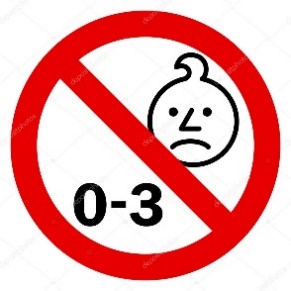
Figure. Graphic symbol for toys that may be hazardous to children under 3 years of age.
The elements of the graphic symbol shall be executed as follows:
- the circle and the crossing line – in red or black;
- the background of the circle – in white;
- the age group for which the toy is not intended, and the outline of the face – in black.
The minimum diameter of the graphic symbol shall be 10 mm, and the proportions between the elements shall correspond to the figure. Where there is insufficient space on the toy, the graphic symbol may be reduced proportionally by no more than 30% of its minimum diameter.
4. Warning inscriptions given in the standards included in the list of standards whose application on a voluntary basis ensures compliance with the requirements of this Technical Regulation, approved by Decision of the Customs Union Commission No. 798 of 23 September 2011, shall be brought to the attention of the user and the purchaser (consumer).
ANNEX 4
to the Technical Regulation
of the Customs Union
"On Safety of Toys"
(TR CU 008/2011)
REQUIREMENTS
for the content of chemical substances or reagents in chemical toys and in play sets that contain chemical substances and are not chemistry experiment sets
Footnote. The Decision was supplemented with Annex 4 in accordance with Decision of the Council of the Eurasian Economic Commission No. 50 of 14.05.2024 (enters into force upon expiry of 180 calendar days from the date of its official publication).
1. In chemical toys and in play sets that contain chemical substances, the content of chemical substances or reagents shall not exceed the maximum permissible quantity established for each substance in accordance with Table 1.
Table 1
Maximum quantity of chemical substances and mixtures in chemical play sets, labelling
Chemical substance (mixture) | Maximum quantity in the set |
Signal word | CAS number |
EINECS | Index number |
Potassium alum | 10 g | — | 10043-67-1 | 233-141-3 | — |
Ammonium carbonate | 5 g | Caution | 10361-29-2 | 233-786-0 | — |
Ammonium chloride | 30 g | Caution | 12125-02-9 | 235-186-4 | 017-014-00-8 |
Ammonium iron(III) sulfate | 5 g | Caution | 10138-04-2 | 233-382-4 | — |
Sodium ammonium hydrogen phosphate | 5 g | Caution | 13011-54-6 | 235-860-8 | — |
Calcium carbonate | 100 g | Caution | 471-34-1 | 207-439-9 | — |
Calcium chloride | 10 g | Caution | 10043-52-4 | 233-140-8 | 017-013-00-2 |
Calcium hydroxide * | 20 g | Danger | 1305-62-0 | 215-137-3 | — |
Calcium nitrate | 5 g | Caution | 10124-37-5 | 233-332-1 | — |
Calcium oxide* | 10 g | Danger | 1305-78-8 | 215-138-9 | — |
Calcium sulfate | 100 g | — | 7778-18-9 | 231-900-3 | — |
Activated carbon** | 100 g | — | 7440-44-0 | 231-153-3 | — |
Citric acid | 20 g | Caution | 77-92-9 | 201-069-1 | — |
Sheet copper | 100 g | Caution | 7440-50-8 | 231-159-6 | — |
Copper(II) oxide | 10 g | Caution | 1317-38-0 | 215-269-1 | — |
Copper(II) sulfate | 15 g | Caution | 7758-98-7 | 231-847-6 | 029-004-00-0 |
Sodium disulfite | 10 g | Danger | 7681-57-4 | 231-673-0 | 016-063-00-2 |
Glycerol | 25 g | — | 56-81-5 | 200-289-5 | — |
Hexamethylenetetramine** | 10 g | Caution | 100-97-0 | 202-905-8 | 612-101-00-2 |
Iron filings/iron powder** | 100 g | Caution | 7439-89-6 | 231-096-4 | — |
Iron(III) chloride | 10 g | Danger | 7705-08-0 | 231-729-4 | — |
Iron(II) sulfate | 10 g | Caution | 7720-78-7 | 231-753-5 |
026-003-00-7 |
Manganese(II) sulfate | 15 g | Caution | 7785-87-7 | 232-089-9 | 025-003-00-4 |
Ninhydrin | 1 g | Caution | 485-47-2 | 207-618-1 | — |
Pepsin A | 10 g | Danger | 9001-75-6 | 232-629-3 | 647-008-00-6 |
Potassium bromide | 15 g | Caution | 7758-02-3 | 231-830-3 | — |
Potassium hexacyanoferrate(III)** | 10 g | — | 13746-66-2 | 237-323-3 | — |
Potassium hexacyanoferrate(II)** | 10 g | — | 13943-58-3 | 237-722-2 | — |
Potassium iodide | 10 g | — | 7681-11-0 | 231-659-4 | — |
Potassium permanganate*** | 15 g | Danger | 7722-64-7 | 231-760-3 | 025-002-00-9 |
Mixture of potassium permanganate and sodium sulfate (1 : 2) (by mass) | 10 g | Danger | — | — | — |
Silver nitrate (aqueous solution with a mass concentration of 0,01 g/cm3) | 10 cm3 | Caution | 7761-88-8 | 231-853-9 | 047-001-00-2 |
Sodium acetate | 20 g | — | 127-09-3 | 204-823-8 | — |
Sodium carbonate | 50 g | Caution | 497-19-8 | 207-838-8 | 011-005-00-2 |
Sodium chloride | 100 g | — | 7647-14-5 | 231-598-3 | — |
Sodium bicarbonate | 50 g | — | 144-55-8 | 205-633-8 | — |
Sodium bisulfate | 30 g | Danger | 7681-38-1 | 231-665-7 | 016-046-00-X |
Sodium silicate solution | 100 cm3 | Danger | — | — | — |
Sodium sulfate | 100 g | — | 7757-82-6 | 231-820-9 | — |
Sodium thiosulfate | 50 g | — | 7772-98-7 | 231-867-5 | — |
Sulfur | 15 g | Caution | 7704-34-9 | 231-722-6 | 016-094-00-1 |
Tannin | 15 g | — | 1401-55-4 | 215-753-2 | — |
Tartaric acid | 20 g | Caution | 87-69-4 | 201-766-0 | — |
Tin(II) chloride | 15 g | Caution | 7772-99-8 | 231-868-0 | — |
Iodine tincture** (ethanolic solution | 10 cm3 | Danger | 7553-56-2 | 231-442-4 | 053-001-00-3 |
Urea** | 10 g | — | 57-13-6 | 200-315-5 | — |
Lactose | 100 g | — | 63-42-3 | 200-559-2 | — |
Lead-free solder | 100 g | — | — | — | — |
Magnesium strip | 3 g | Caution | — | — | — |
Magnesium sulfate | 25 g | — | 7487-88-9 | 231-298-2 | — |
Manganese(IV) dioxide | 5 g | Caution | 1313-13-9 | 215-202-6 |
025-001-00-3 |
Zinc powder (stabilized) / zinc granules | 20 g | Caution | 7440-66-6 | 231-175-3 | 030-001-01-9 |
Zinc sulfate (heptahydrate) | 20 g | Danger | 7446-20-0 | 231-793-3 | — |
Unless otherwise specified, the maximum quantities of solid substances refer to anhydrous chemicals. Anhydrous substances may be replaced with an equivalent quantity of hydrated chemicals. | |||||
* Each set must contain only one of these substances. | |||||
2. When indicators are supplied in solution, the content of dry matter therein shall not exceed the quantity and concentrations specified in Table 2.
Table 2
Maximum quantity of indicators and their concentration in chemical sets, labelling
Chemical substance (mixture) | Maximum quantity per set | Signal word (labelling) | CAS Number |
EINECS | INDEX Number |
Eosin | 1 g | Осторожно | 17372-87-1 | 241-409-6 | — |
Iodine (aqueous solution | 10 cm3 | — | 7553-56-2 | 231-442-4 | 053-001-00-3 |
Blue litmus | 1 g | — | — | — | — |
Red litmus | 1 g | — | 1393-92-6 | 215-739-6 | — |
Luminol (5-percent mixture (by mass) with sodium sulphate) | 3 g | — | 521-31-3 | 208-309-4 | — |
Methyl orange (15-percent mixture (by mass) with sodium sulphate) | 3 g | Осторожно | 547-58-0 | 208-925-3 | — |
Methylene blue | 1 g | Осторожно | 61-73-4 | 200-515-2 | — |
Phenol red | 1 g | Осторожно | 143-74-8 | 205-609-7 | — |
Thymol blue | 1 g | — | 76-61-9 | 200-973-3 | — |
Universal indicator paper | 1 pad | — | — | — | — |
3. Dyes and colouring materials not listed in Table 2 may be included in chemical sets only if they do not react with the substances and mixtures of the set and do not belong to the following hazard classes:
- acute toxicity to the body;
- skin damage (necrosis and irritation);
- serious eye damage (irritation);
- sensitising effect;
- mutagenicity;
- carcinogenicity;
- effects on reproductive function;
- specific target organ toxicity — single exposure (affecting individual target organs and systems);
- specific target organ toxicity — repeated exposure (affecting individual target organs and systems);
- aspiration hazard.
Dyes permitted for use in food products or cosmetics may be included in chemical sets.
APPROVED
by Decision of the Customs Union Commission
of 23 September 2011 No. 798
(as amended by Decision of the Board
of the Eurasian Economic Commission
of 2 December 2024 No. 136)
LIST
of international and regional (interstate) standards and, in their absence, national (state) standards, the voluntary application of which ensures compliance with the requirements of the Technical Regulation of the Customs Union "On Safety of Toys" (TR CU 008/2011)
Footnote. The List as amended by Decision of the Board of the Eurasian Economic Commission of 02.12.2024 No. 136 (enters into force upon expiry of 30 calendar days from the date of its official publication and applies to legal relations that arose from 26.11.2024).
No. | Structural element or object of technical regulation of the technical regulation of the Eurasian Economic Union | Designation and title of the standard | Note | |
1 | 2 | 3 | 4 | |
1 | Article 2 | GOST 35099-2024 "Toys. Classification. Terms and definitions" | applies from 01.07.2025 | |
2 |
paragraphs 2.1, 2.4, 3.2.1 – 3.2.5, 3.2.7 – 3.2.9, |
GOST EN 71-1-2014 "Toys. Safety requirements. Part 1. Mechanical and physical properties" | applies until 01.07.2025 | |
3 |
GOST EN 71-1-2022 "Toys. Safety requirements. Part 1. Mechanical and physical properties" | |||
4 | GOST EN 71-8-2014 "Toys. Safety requirements. Part 8. Activity toys for domestic use" | applies until 01.07.2025 | ||
5 | GOST EN 71-8-2021 "Toys. Safety requirements. Part 8. Activity toys for domestic use" | |||
6 | GOST EN 71-14-2018 "Toys. Safety requirements. Part 14. Trampolines for domestic use" | applies until 01.07.2025 | ||
7 | GOST EN 71-14-2022 "Toys. Safety requirements. Part 14. Trampolines for domestic use" | |||
8 |
paragraphs 2.2, 3.2.12 | clauses 1.3, 2.1.10, 2.13.7, 2.30.1 – 2.30.6, 2.31.1 (except letter height) and 2.31.2 of GOST 25779-90 "Toys. General safety requirements and inspection methods" | ||
9 | paragraph 3.2.6 of Article 4 | clause 5.2 (for all age groups) of GOST EN 71-1-2014 "Toys. Safety requirements. Part 1. Mechanical and physical properties" | applies until 01.07.2025 | |
10 | clause 5.2 (for all age groups) of GOST EN 71-1-2022 "Toys. Safety requirements. Part 1. Mechanical and physical properties" | |||
11 | paragraph 3.2.10 of Article 4 | clause 4.18 of GOST EN 71-1-2014 "Toys. Safety requirements. Part 1. Mechanical and physical properties" | applies until 01.07.2025 | |
12 | clause 4.18 of GOST EN 71-1-2022 "Toys. Safety requirements. Part 1. Mechanical and physical properties" | |||
13 |
clauses 2.25.1 and 2.25.2 of GOST 25779-90 | |||
14 | paragraph 3.3 of Article 4 | GOST ISO 8124-2-2014 "Safety of toys. Part 2. Flammability" | ||
15 | GOST EN 71-1-2014 "Toys. Safety requirements. Part 1. Mechanical and physical properties" | applies until 01.07.2025 | ||
16 | GOST EN 71-1-2022 "Toys. Safety requirements. Part 1. Mechanical and physical properties" | |||
17 | paragraphs 3.4 and 3.5 of Article 4, Annex 2 | GOST ISO 8124-3-2014 "Safety of toys. Part 3. Migration of certain elements" | ||
18 |
GOST EN 71-4-2014 "Toys. Safety requirements. Part 4. Sets for chemical experiments | applies until 01.07.2025 | ||
19 | GOST 35097-2024 (EN 71-4:2020) "Toys. Safety requirements. Part 4. Sets for chemical experiments and related activities" | |||
20 |
GOST EN 71-5-2018 "Toys. | |||
21 |
GOST EN 71-7-2014 "Toys. | applies until 01.07.2025 | ||
22 | GOST EN 71-7-2021 "Toys. Safety requirements. Part 7. Finger paints. Technical requirements and test methods" | |||
23 | GOST EN 71-13-2018 "Toys. Safety requirements. Part 13. Board games for developing the sense of smell, kits for making perfumery and cosmetic products, and taste games" | |||
24 | paragraphs 3.2.28, 3.6.1 – 3.6.3 and 5 of Article 4 | GOST IEC 62115-2014 "Electric toys. Safety requirements" | applies until 01.07.2025 | |
25 | GOST IEC 62115-2022 "Electric toys. Safety" | |||
26 | paragraph 3.2.29 of Article 4 | GOST IEC 60825-1-2013 "Safety of laser equipment. Part 1. Equipment classification, requirements and user's guide" | applies until 01.07.2025 | |
27 | GOST IEC 60825-1-2023 "Safety of laser equipment. Part 1. Equipment classification and requirements" | |||
28 | paragraph 3.9 of Article 4 | GOST EN 71-1-2014 "Toys. Safety requirements. Part 1. Mechanical and physical properties" | applies until 01.07.2025 | |
29 | GOST EN 71-1-2022 "Toys. Safety requirements. Part 1. Mechanical and physical properties" | |||
30 | paragraph 2.5 of Article 4 | GOST 25779-90 "Toys. General safety requirements and inspection methods" | applies until 01.07.2025 | |
31 |
clauses 4.1 and 4.2 (first listed item | |||
32 | item 3.7 of Annex 2 | GOST 33795-2016 "Wood raw materials, timber, semi-finished products and articles made of wood and wood-based materials. Permissible specific activity of radionuclides, sampling and methods for measuring the specific activity of radionuclides" | applies from 01.07.2025 | ". |
Approved
by Decision of the Customs Union Commission
of 23 September 2011 No. 798
(as amended by Decision of the Board
of the Eurasian Economic Commission
of 26 September 2017 No. 124)
LIST
of international and regional (interstate) standards and, in their absence, national (state) standards containing rules and methods of research (testing) and measurement, including sampling rules, necessary for the application and implementation of the requirements of the Technical Regulation of the Customs Union "On Safety of Toys" (TR CU 008/2011) and for the conformity assessment of objects of technical regulation
Footnote. The List as amended by Decision of the Board of the Eurasian Economic Commission No. 124 of 26.09.2017 (enters into force upon expiry of 30 calendar days from the date of its official publication); with amendments introduced by Decisions of the Board of the Eurasian Economic Commission No. 221 of 17.12.2019 (enters into force upon expiry of 30 calendar days from the date of its official publication); No. 80 of 23.06.2020 (enters into force upon expiry of 30 calendar days from the date of its official publication); No. 4 of 11.01.2022 (enters into force upon expiry of 30 calendar days from the date of its official publication); No. 144 of 18.10.2022 (enters into force upon expiry of 30 calendar days from the date of its official publication); No. 136 of 02.12.2024 (enters into force upon expiry of 30 calendar days from the date of its official publication and applies to legal relations that arose from 26.11.2024).
No. | Elements of the Technical Regulation | Standard designation | Document title | Note |
1 | 2 | 3 | 4 | 5 |
1. | Annex 2 | GOST 15820-82 | Polystyrene and styrene copolymers. Gas chromatographic method for the determination of residual monomers and non-polymerizing impurities | |
2. | Excluded by Decision of the Board of the Eurasian Economic Commission No. 221 of 17.12.2019 (enters into force upon expiry of 30 calendar days from the date of its official publication). | |||
3. | GOST 18165-2014 | Water. Methods for the determination of aluminium content | ||
4. | Excluded by Decision of the Board of the Eurasian Economic Commission No. 136 of 02.12.2024 (enters into force upon expiry of 30 calendar days from the date of its official publication and applies to legal relations arising from 26.11.2024). | |||
41 | GOST 34446-2018 | Toys. Sampling | ||
42 | GOST 33795-2016 | Wood raw materials, timber, semi-finished products and products made of wood and wood-based materials. Permissible specific activity of radionuclides, sampling and methods for measuring the specific activity of radionuclides |
applies | |
5. | clause 3.1 of Article 4, Annex 2 | GOST 22648-77 | Plastics. Methods for the determination of hygienic indicators | |
6. | GOST 24295-80 | Enamelled steel household utensils. Methods of extract analysis | ||
7. | Annex 2 | GOST 25737-91 (ISO 6401-85) | Plastics. Vinyl chloride homopolymers and copolymers. Determination of residual vinyl chloride monomer. Gas chromatographic method | applies until 01.07.2025 |
71 | GOST ISO 6401-2021 | Plastics. Polyvinyl chloride. Determination of residual vinyl chloride monomer content. Gas chromatographic method. | ||
8. | clause 3.1 of Article 4, Annex 2 | GOST 26150-84 | Polymeric finishing building materials and products based on polyvinyl chloride. Method of sanitary-chemical assessment | |
81 | clause 3.7, Annex 2 | GOST 33795-2016 | Wood raw materials, timber, semi-finished products and products made of wood and wood-based materials. Permissible specific activity of radionuclides, sampling and methods for measuring the specific activity of radionuclides |
applies |
9. | Annex 2 | GOST 30108-94 | Building materials and products. Determination of the specific effective activity of natural radionuclides | |
10. | GOST 30351-2001 | Polyamides, polyamide fibres, fabrics and films. Determination of the mass fraction of residual caprolactam and low-molecular-weight compounds and their migration concentration into water. Liquid and gas-liquid chromatography methods | ||
11. | GOST 31870-2012 | Drinking water. Determination of element content by atomic spectrometry methods | ||
12. | STB GOST R 51309-2001 | Drinking water. Determination of element content by atomic spectrometry methods | ||
13. | ST RK GOST R 51309-2003 | Drinking water. Determination of element content by atomic spectrometry methods | ||
14. | GOST 31949-2012 | Drinking water. Method for the determination of boron content | ||
15. | GOST 31956-2013 | Water. Methods for the determination of chromium (VI) and total chromium content | ||
16 | clauses 2.1, 2.4, 3.2.1 – 3.2.20, 3.2.22, 3.2.25, 4 and 5 of Article 4 | GOST EN 71-1-2014 | Toys. Safety requirements. Part 1. Mechanical and physical properties | applies until 01.07.2025 |
161 | GOST EN 71-1-2022 | Toys. Safety requirements. Part 1. Mechanical and physical properties | ||
17 | GOST EN 71-8-2014 | Toys. Safety requirements. Part 8. Activity toys for domestic use | applies until 01.07.2025 | |
171 | GOST EN 71-8-2021 | Toys. Safety requirements. Part 8. Activity toys for domestic use | ||
18 | GOST EN 71-14-2018 | Toys. Safety requirements. Part 14. Trampolines for domestic use | applies until 01.07.2025 | |
181 | GOST EN 71-14-2022 | Toys. Safety requirements. Part 14. Trampolines for domestic use | ||
19 | clauses 2.2, 3.2.10, 3.2.12 (fourth paragraph), 3.2.21, 3.2.26 and 3.2.27 of Article 4 | GOST 25779-90 | Toys. General safety requirements and inspection methods | |
20. | clause 3.3 of Article 4 | GOST ISO 8124-2-2014 | Safety of toys. Part 2. Flammability | |
21. | Excluded by Decision of the Board of the Eurasian Economic Commission No. 221 of 17.12.2019 (enters into force upon expiry of 30 calendar days from the date of its official publication). | |||
22. | GOST EN 71-1-2014 | Toys. Safety requirements. Part 1. Mechanical and physical properties | ||
23 | GOST EN 71-4-2014 | Toys. Safety requirements. Part 4. Sets for chemical experiments and similar activities | applies until 01.07.2025 | |
231 | GOST EN 71-5-2018 | Toys. Safety requirements. Part 5. Play sets containing chemical substances and not classified as sets for chemical experiments |
applies | |
232 | GOST 35097-2024 (EN 71-4:2020) | Toys. Safety requirements. Part 4. Sets for chemical experiments and similar activities | ||
24. | clauses 3.4, 3.5 and 3.8 of Article 4, Annex 2 | GOST ISO 8124-3-2014 | Safety of toys. Part 3. Migration of certain elements | |
25. | GOST EN 71-13-2018 | Toys. Safety requirements. Part 13. Olfactory board games, kits for making perfumery and cosmetic products, and gustatory games | applies from 01.11.2021 | |
26. | GOST EN 71-4-2014 | Toys. Safety requirements. Part 4. Sets for chemical experiments and similar activities | applies until 01.07.2025 | |
261 | GOST 35097-2024 (EN 71-4:2020) | Toys. Safety requirements. Part 4. Sets for chemical experiments and similar activities | ||
27. | Excluded by Decision of the Board of the Eurasian Economic Commission No. 136 of 02.12.2024 (enters into force upon expiry of 30 calendar days from the date of its official publication and applies to legal relations arising from 26.11.2024). | |||
271 | GOST EN 71-5-2018 | Toys. Safety requirements. Part 5. Play sets containing chemical substances and not classified as sets for chemical experiments | ||
28. | GOST EN 71-7-2014 | Toys. Safety requirements. Part 7. Finger paints. Technical requirements and test methods | applies until 01.07.2025 | |
281 | GOST EN 71-7-2021 |
Toys. Safety requirements. Part 7. Finger paints. Technical requirements | ||
29. | clauses 3.2.28, 3.2.29, 3.6.1 – 3.6.3 and 5 of Article 4 | GOST IEC 62115-2014 | Electric toys. Safety requirements | applies until 01.07.2025 |
30. | GOST IEC 62115-2022 | Electric toys. Safety | ||
31. | GOST IEC 60825-1-2013 | Safety of laser products. Part 1. Equipment classification, requirements and user's guide | applies until 01.07.2025 | |
32. | GOST IEC 60825-1-2023 | Safety of laser products. Part 1. Equipment classification and requirements | ||
33 |
clause 3.9 | GOST EN 71-1-2014 | Toys. Safety requirements. Part 1. Mechanical and physical properties | applies until 01.07.2025 |
331 | GOST EN 71-1-2022 | Toys. Safety requirements. Part 1. Mechanical and physical properties | ||
332 |
clause 2.5 |
GOST | Toys. General safety requirements and test methods | applies until 01.07.2025 |
333 | clauses 5.1 and 5.3 – 5.5 of GOST 34399-2018 | Toys. Protective and decorative coating and surface painting. Safety requirements and test methods | ||
34. | Deleted by Decision of the Board of the Eurasian Economic Commission of 02.12.2024 No. 136 (enters into force upon expiry of 30 calendar days from the date of its official publication and applies to legal relations that arose from 26.11.2024). | |||
341 | Annex 2 |
GOST ISO | Microbiology of food and animal feeding stuffs. General requirements and guidance for microbiological examinations | |
35. | Deleted by Decision of the Board of the Eurasian Economic Commission of 02.12.2024 No. 136 (enters into force upon expiry of 30 calendar days from the date of its official publication and applies to legal relations that arose from 26.11.2024). | |||
351 | GOST ISO 16000-6-2016 | Indoor air. Part 6. Determination of volatile organic compounds in indoor and test chamber air by active sampling on Tenax TA sorbent, thermal desorption and gas chromatography using MSD/FID | ||
36. | GOST 31950-2012 | Methods for determination of total mercury content by flameless atomic absorption spectrometry | ||
37. | STB GOST R 51212-2001 | Drinking water. Methods for determination of total mercury content by flameless atomic absorption spectrometry | ||
38. | STB 1087-97 | Children's modelling clay. Specifications | ||
39. |
GOST EN | Toys. Safety requirements. Part 1. Mechanical and physical properties | ||
40. | Deleted by Decision of the Board of the Eurasian Economic Commission of 17.12.2019 No. 221 (enters into force upon expiry of 30 calendar days from the date of its official publication). | |||
41. | STB GOST R 51310-2001 | Drinking water. Methods for determination of benzo(a)pyrene content | ||
42. | GOST 31860-2012 | Drinking water. Method for determination of benzo(a)pyrene content | ||
43. | GOST 31280-2004 |
Furs and fur products. Harmful substances. Methods for detection | ||
44. |
GOST R | Water. Methods for determination of formaldehyde content | ||
45. | GOST 33451-2015 | Packaging. Determination of dioctyl phthalate and dibutyl phthalate content in model media by gas chromatography | ||
46. | GOST 33449-2015 | Packaging. Determination of dimethyl terephthalate content in model media by gas chromatography | ||
47. | GOST 33448-2015 | Packaging. Determination of acetaldehyde and acetone content in model media by gas chromatography | ||
48. |
STB ISO | Water quality. Determination of selected elements by inductively coupled plasma optical emission spectrometry (ICP-OES) | ||
49. | Deleted by Decision of the Board of the Eurasian Economic Commission of 02.12.2024 No. 136 (enters into force upon expiry of 30 calendar days from the date of its official publication and applies to legal relations that arose from 26.11.2024). | |||
50. | Sanitary Rules and Norms 9-29-95 (RF No. 2.1.8.042-96) * | Sanitary norms for permissible levels of physical factors in the domestic use of consumer goods | ||
51. | MU 1.1.037-95 * | Biotesting of products made of polymeric and other materials | ||
52. | MU No. 11-12-25-96 * | Methodological guidelines for the determination of acrylonitrile in extracts (sweat fluid) from "Nitron D" fibre by gas-liquid chromatography | ||
53. | MU No. 71-93 * | Methodological guidelines for the gas chromatographic measurement of acetone concentrations in air | ||
54. | MU No. 75-92 * | Methodological guidelines for the determination of formaldehyde in water, aqueous extracts from polymeric materials and food-simulating model media | ||
55. | MU No. 76-93 * | Methodological guidelines for the gas chromatographic measurement of methanol and ethanol concentrations in ambient air | ||
56. | MU No. 266-92 * | Methodological guidelines for the gas chromatographic measurement of formaldehyde concentrations in ambient air | ||
57. | MU No. 268-92 * | Methodological guidelines for the gas chromatographic measurement of hydrogen cyanide and acrylonitrile concentrations in air | ||
58. | MU 942-72 * | Methodological guidelines for the determination of the migration of organic solvents from polymeric materials into air, model solutions, and dry and liquid food products in contact with them | ||
59. | MU No. 1424-76 * | Methodological guidelines for sampling from environmental objects and preparing the samples for subsequent determination of carcinogenic polycyclic aromatic hydrocarbons | ||
60. | MU No. 2563-82 * | Methodological guidelines for the photometric measurement of acetaldehyde concentrations in workplace air | ||
61. | MU No. 2704-83 * | Methodological guidelines for the gas chromatographic determination of methyl toluate, dinyl and dimethyl terephthalate in air | ||
62. | MU No. 2902-83 * |
Methodological guidelines for the gas chromatographic measurement of concentrations of methyl, ethyl, isopropyl, | ||
63. | MU No. 3999-85 * | Methodological guidelines for the gas chromatographic measurement of ethylene glycol and methanol concentrations in workplace air | ||
64. | MU 4077-86 * | Methodological guidelines for the sanitary and hygienic testing of rubbers and rubber products intended for contact with food products | ||
65. | MU 4149-86 * | Methodological guidelines for state sanitary supervision of the production and use of polyolefin-class polymeric materials intended for contact with food products | ||
66. | MU No. 4167-86 * |
Methodological guidelines for the gas chromatographic measurement of concentrations of gasoline, benzene, toluene, ethylbenzene, | ||
67. | MU 4395-87 * | Methodological guidelines for the hygienic assessment of lacquered cans | ||
68. | MU No. 4477-87 * |
Methodological guidelines for the gas chromatographic measurement of concentrations of benzene, toluene and | ||
69. | MU 4628-88 * | Methodological guidelines for the gas chromatographic determination of residual monomers and non-polymerizable impurities released from polystyrene plastics into water, model media and food products | ||
70. | MU No. 4759-88 * | Methodological guidelines for the gas chromatographic measurement of styrene concentrations in workplace air | ||
71. | МУК 2.3.3.052- 96 * | Sanitary and chemical testing of products made of polystyrene and styrene copolymers | ||
72. | МУК 4.1/4.3.1485-03* | Hygienic assessment of clothing for children, adolescents and adults | ||
73. | МУК 4.1/4.3.2038-05 * | Sanitary and epidemiological assessment of toys | ||
74. | МУК 4.1.025-95 * | Measurement of concentrations of (meth)acrylic compounds in environmental media | ||
75. | Deleted by Decision of the Board of the Eurasian Economic Commission No. 221 of 17.12.2019 (enters into force upon expiry of 30 calendar days from the date of its official publication). | |||
76. | МУК 4.1.580-96 * | Determination of acrylic acid nitrile released from polyacrylonitrile fibre into air by gas chromatography | ||
77. | МУК 4.1.598-96 * | Guidelines for the gas chromatographic determination of aromatic, sulphur-containing and halogen-containing substances, methanol, acetone and acetonitrile in ambient air | ||
78. | МУК 4.1.599-96 * | Guidelines for the gas chromatographic determination of acetaldehyde in ambient air | ||
79. | МУК 4.1.600-96 * | Guidelines for the gas chromatographic determination of acetone, methanol and isopropanol in ambient air | ||
80. | МУК 4.1.607-06 * | Guidelines for the determination of vinyl chloride in ambient air by gas-liquid chromatography | ||
81. | МУК 4.1.611-96 * | Guidelines for the gas chromatographic determination of dimethyl phthalate in ambient air | ||
82. | МУК 4.1.614-96 * | Guidelines for the determination of diethyl phthalate in ambient air by high-performance liquid chromatography | ||
83. | МУК 4.1.617-96 * | Guidelines for the gas chromatographic determination of xylenols, cresols and phenol in ambient air | ||
84. | МУК 4.1.624-96 * | Methodological guidelines for the gas chromatographic determination of methyl and ethyl alcohols in ambient air | ||
85. | МУК 4.1.646-96 * | Methodological guidelines for the gas chromatographic determination of halogen-containing substances in water | ||
86. | МУК 4.1.647-96 * | Methodological guidelines for the gas chromatographic determination of phenol in water | ||
87. | МУК 4.1.649-96 * | Methodological guidelines for the chromatography–mass spectrometry determination of volatile organic substances in water | ||
88. | МУК 4.1.650-96 * | Methodological guidelines for the gas chromatographic determination of acetone, methanol, benzene, toluene, ethylbenzene, pentane, o-, m-, p-xylene, hexane, octane and decane in water | ||
89. | МУК 4.1.651-96 * | Methodological guidelines for the gas chromatographic determination of toluene in water | ||
90. | МУК 4.1.652-96 * | Methodological guidelines for the gas chromatographic determination of ethylbenzene in water | ||
91. | МУК 4.1.654-96 * |
Methodological guidelines for the gas chromatographic determination of butanal, butanol, isobutanol, 2-ethylhexanal, | ||
92. | МУК 4.1.656-96 * | Methodological guidelines for the gas chromatographic determination of methyl acrylate and methyl methacrylate in water | ||
93. | МУК 4.1.657-96 * | Methodological guidelines for the gas chromatographic determination of butyl acrylate and butyl methacrylate in water | ||
94. | МУК 4.1.658-96 * | Methodological guidelines for the gas chromatographic determination of acrylonitrile in water | ||
95. | МУК 4.1.662-97 * | Methodological guidelines for the determination of the mass concentration of styrene in ambient air by gas chromatography | ||
96. | МУК 4.1.737-99 * | Chromatography–mass spectrometry determination of phenols in water | ||
97. | МУК 4.1.738-99 * | Chromatography–mass spectrometry determination of phthalates and organic acids in water | ||
98. | МУК 4.1.739-99 * | Chromatography–mass spectrometry determination of benzene, toluene, chlorobenzene, ethylbenzene, o-xylene and styrene in water | ||
99. | МУК 4.1.741-99 * | Chromatography–mass spectrometry determination of phenanthrene, anthracene, fluoranthene, pyrene, chrysene and benz(a)pyrene in water | ||
100 | МУК 4.1.742-99 * | Stripping voltammetric measurement of the concentration of zinc, cadmium, lead and copper ions in water | ||
101. | МУК 4.1.745-99 * | Gas chromatographic determination of dimethyl terephthalate (dimethyl ester of terephthalic acid) in water | ||
102. | МУК 4.1.752-99 * | Gas chromatographic determination of phenol in water | ||
103. | МУК 4.1.753-99 * | Ion chromatographic determination of formaldehyde in water | ||
104. | МУК 4.1.1044а- 01 * | Gas chromatographic determination of acrylonitrile, acetonitrile, dimethylamine, dimethylformamide, diethylamine, propylamine, triethylamine and ethylamine in air | ||
105. | МУК 4.1.1046(а)-01 * | Gas chromatographic determination of ortho-, meta- and para-xylenes in air | ||
106. | МУК 4.1.1053-01* | Ion chromatographic determination of formaldehyde in air | ||
107. | МУК 4.1.1206-03* | Gas chromatographic determination of acrylonitrile, acetonitrile, dimethylformamide, diethylamine and triethylamine in water | ||
108. | МУК 4.1.1209-03* |
Gas chromatographic determination of | ||
109. | МУК 4.1.1256-03* | Measurement of the mass concentration of zinc by the fluorimetric method in samples of drinking water and water from surface and underground sources in use | ||
110. | МУК 4.1.1255-03* | Measurement of the mass concentration of aluminium by the fluorimetric method in samples of drinking water and water from surface and underground sources in use | ||
111. | МУК 4.1.1257-03* | Measurement of the mass concentration of boron by the fluorimetric method in samples of drinking water and water from surface and underground sources in use | ||
112. | МУК 4.1.1263-03* | Measurement of the mass concentration of total and volatile phenols by the fluorimetric method in samples of drinking water and water from surface and underground sources in use | ||
113. | МУК 4.1.1265-03* | Measurement of the mass concentration of formaldehyde by the fluorimetric method in samples of drinking water and water from surface and underground sources in use | ||
114. | МУК 4.1.1271-03* | Measurement of the mass concentration of phenol by the fluorimetric method in workplace air and in ambient air of populated areas | ||
115. | МУК 4.1.1272-03* | Measurement of the mass concentration of formaldehyde by the fluorimetric method in workplace air and in ambient air of populated areas | ||
116. | МУК 4.1.1273-03* | Measurement of the mass concentration of benz(a)pyrene in ambient air and in workplace air by high-performance liquid chromatography with fluorimetric detection | ||
117. | МУК 4.1.1478-03* | Determination of phenol in ambient air and in the indoor air of residential and public buildings by high-performance liquid chromatography | ||
118. | МУК 4.2.801-99 * | Methods of microbiological control of perfumery and cosmetic products | ||
119. | МУК 2715-83 * | Methodological guidelines for the gas chromatographic determination of ethylchlorohydrin (ECH) in air | ||
120 | Deleted by Decision of the Board of the Eurasian Economic Commission No. 136 of 02.12.2024 (enters into force upon the expiry of 30 calendar days from the date of its official publication and applies to legal relations that arose from 26.11.2024). | |||
121. | Deleted by Decision of the Board of the Eurasian Economic Commission No. 136 of 02.12.2024 (enters into force upon the expiry of 30 calendar days from the date of its official publication and applies to legal relations that arose from 26.11.2024). | |||
122. | Deleted by Decision of the Board of the Eurasian Economic Commission No. 136 of 02.12.2024 (enters into force upon the expiry of 30 calendar days from the date of its official publication and applies to legal relations that arose from 26.11.2024). | |||
123. | Deleted by Decision of the Board of the Eurasian Economic Commission No. 136 of 02.12.2024 (enters into force upon the expiry of 30 calendar days from the date of its official publication and applies to legal relations that arose from 26.11.2024). | |||
1231 | МУК 4.1.3166-14* | Gas chromatographic determination of hexane, heptane, acetaldehyde, acetone, methyl acetate, ethyl acetate, methanol, isopropanol, acrylonitrile, n-propanol, n-propyl acetate, butyl acetate, isobutanol, n-butanol, benzene, toluene, ethylbenzene, m-, o- and p-xylenes, isopropylbenzene, styrene and α-methylstyrene in water and in aqueous extracts from materials of various composition | certificate of validation No. 01. 00282-2008/ 0153.16.01.13, register number ФР.1.31.2013. 16740 | |
1232 | МУК 4.1.3167-14* |
Gas chromatographic determination of hexane, heptane, benzene, toluene, ethylbenzene, m-, o-, |
certificate of validation No. 01. | |
1233 | МУК 4.1.3168-14* |
Gas chromatographic determination of dimethyl phthalate, dimethyl terephthalate, diethyl phthalate, dibutyl phthalate, butyl benzyl phthalate, | applies from 01.04.2021, certificate of attestation No. 01. 00282-2008/0146.14.12.12 dated 14.12.2012, registry number ФР.1.31.2013.16763 | |
1234 | МУК 4.1.3169-14* |
Gas chromatographic determination of dimethyl phthalate, dimethyl terephthalate, diethyl phthalate, dibutyl phthalate, butyl benzyl phthalate, |
certificate of attestation No. 01. | |
1235 | МУК 4.1.3170-14* | Gas chromatographic determination of acetaldehyde, acetone, methyl acetate, ethyl acetate, methanol, iso-propanol, ethanol, n-propyl acetate, n-propanol, iso-butyl acetate, butyl acetate, iso-butanol, n-butanol in ambient air, the air of test chambers and enclosed spaces | certificate of attestation No. 01.00282-2008/0154.16.01.13, registry number ФР.1.31.2013.16741 | |
1236 | МУК 4.1.3171-14* |
Gas chromatographic determination of acetaldehyde, acetone, methyl acetate, methanol, ethanol, methyl acrylate, methyl methacrylate, ethyl acrylate, | certificate of attestation No. 01.00282-2008/0160.19.03.13, registry number ФР.1.31.2013.16751 | |
124. |
МР № 29 |
Gas chromatographic determination of the mass concentration of benzene, toluene, ethylbenzene, | ||
125. | МР №29 ФЦ/2688-03 * | Rapid method for assessing the toxicity of air samples based on water-soluble components using bovine sperm as the test object | ||
126 |
МР № 29 |
Gas chromatographic determination of the mass concentration of hexane, heptane, acetaldehyde, acetone, methyl acetate, ethyl acetate, methanol, | ||
127. | MP 1328-75 * | Guidelines for the determination of caprolactam in water, air and biological media | ||
128. | МР 1503-76 * | Guidelines for the determination of hexamethylenediamine in water in sanitary-chemical studies of polymeric materials used in the food and textile industries | ||
129. | МР 1870-78 | Guidelines for the mercurimetric determination of small quantities of vinyl acetate in water, water-alcohol solutions and food products | applies until 01.07.2025 | |
130. | МР № 1941-78 * |
Guidelines for the determination of vinyl chloride in PVC and PVC-based polymeric materials, | ||
131. | МР 2915-82 | Guidelines for the determination of vinyl acetate in water by gas-liquid chromatography | applies until 01.07.2025 | |
132. | МР 2946-83 * | Guidelines. Measurement of impulse local vibration | ||
133. | РД 52.04.186-89 * | Guidance on atmospheric pollution monitoring | ||
134. | Deleted by Decision of the Board of the Eurasian Economic Commission of 02.12.2024 No. 136 (enters into force upon the expiry of 30 calendar days from the date of its official publication and applies to legal relations that arose from 26.11.2024). | |||
1341 | РД 52.24.488-2006* | Mass concentration of volatile phenols in waters. Procedure for performing measurements by the extraction-photometric method after steam distillation |
certificate of attestation registry number ФР.1.31.2007. 03466 | |
135. | РД 52.24.492- 2006 * | Mass concentration of formaldehyde in waters. Procedure for performing measurements by the photometric method with acetylacetone | ||
136. | ПНД Ф 14.1:2:4.36-95 * | Procedure for performing measurements of the mass concentration of boron in samples of natural, drinking and waste water using the "Fluorat-02" liquid analyzer | ||
137. | ПНД Ф 14.1:2:4.139-98 * | Procedure for performing measurements of cobalt, nickel, copper, chromium, zinc, manganese, iron, silver in drinking, natural and waste waters by flame atomic absorption spectrometry | ||
138. | ПНД Ф 14.1:2:4.140-98 * | Procedure for performing measurements of the mass concentrations of beryllium, vanadium, bismuth, cadmium, cobalt, copper, molybdenum, arsenic, nickel, tin, lead, selenium, silver, antimony and chromium in drinking, natural and waste waters by atomic absorption spectrometry with electrothermal atomization | ||
139. | ПНД Ф 14.1:2:4.143-98 * | Procedure for performing measurements of aluminium, barium, boron, iron, cobalt, manganese, copper, nickel, strontium, titanium, chromium and zinc in drinking, natural and waste waters by ICP spectrometry | ||
140. |
ПНД Ф | Procedure for performing measurements of the mass concentration of iron, cadmium, lead, zinc and chromium ions in samples of natural and waste waters by flame atomic absorption spectrometry | ||
141. | ПНД Ф 14.1:2:4.182-02 * | Quantitative chemical analysis of waters. Procedure for performing measurements of the mass concentration of phenols in samples of drinking, natural and waste waters by the fluorimetric method using the "Fluorat-02" liquid analyzer | ||
142. | ПНД Ф 14.1:2:4.185-02 * | Procedure for performing measurements of the mass concentration of benzo(a)pyrene in samples of natural, drinking and waste waters by cryoluminescence using the "Fluorat-02-2M" liquid analyzer and the "KRIO-1" attachment | ||
143. | ПНД Ф 14.1:2:4.186-02 * | Procedure for performing measurements of the mass concentration of benzo(a)pyrene in samples of natural, drinking and waste waters by high-performance liquid chromatography (HPLC) using the "Fluorat-02" liquid analyzer as a fluorimetric detector (М01-21-01) | ||
144. | ПНД Ф 14.2:4.187-02 * | Procedure for performing measurements of the mass concentration of formaldehyde in samples of natural, drinking and waste waters using the "Fluorat-02" liquid analyzer | ||
145. |
ПНД Ф | Procedure for performing measurements of polycyclic aromatic hydrocarbons in drinking and natural waters | ||
146. | НДП 30.2:3.2-95 (НДП 30.2:3.2-04) * | Procedure for performing measurements of e-caprolactam in natural and waste waters | ||
1461 | ПНД Ф 14.1:2:4.211-05* | Method for measuring the mass concentration of caprolactam in samples of natural water and wastewater by gas chromatography | certificate of validation No. 224.01.11.083/2004 dated 23.04.2004, register number ФР.1.31.2013.13995 | |
147. |
Instruction | Methods for determining and assessing microbiological indicators of the safety and harmlessness to humans of consumer goods, paper and board in contact with food products | New | |
148. |
Instruction | Methods of sanitary and microbiological control of products intended for children and adolescents | ||
149. |
Instruction 1.1.11-12-35- | Requirements for setting up experimental studies for the primary toxicological assessment and hygienic regulation of substances | ||
150. | Instruction 2.3.3.10-15-64-2005 * | Sanitary and chemical testing of articles made of polymeric and other synthetic materials in contact with food products | ||
151. | Instruction 4.1.10-12-39- 2005 * |
Method for measuring concentrations of acetone, methanol, benzene, toluene, ethylbenzene, pentane, | ||
152. | Instruction 4.1.10-12-40- 2005 * | Method for measuring concentrations of toluene in water by gas chromatography | ||
153. | Instruction 4.1.10-15-90- 2005 * | Exercise of state sanitary supervision over the production and use of polymeric materials of the polyolefin class intended for contact with food products | ||
154. | Instruction 4.1.10-14-91- 2005 * | Gas chromatographic method for determining residual monomers and non-polymerizable impurities released from polystyrene plastics into water, model media and food products | ||
155. | Instruction 4.1.10-15-92- 2005 * | Sanitary and chemical testing of rubbers and articles made of them intended for contact with food products | ||
156. | Instruction 4.1.10-14-101-2005 * | Methods for testing polymeric materials for hygienic assessment | ||
157. | Instruction No. 016-1211 * | Methods for assessing the hygienic safety of certain types of products for children | ||
158. | Instruction No. 880-71 * | Instruction on sanitary and chemical testing of articles made of polymeric and other synthetic materials intended for contact with food products | ||
159. | Instruction No. 4259-87 * | Instruction on sanitary and chemical testing of articles made of polymeric and other synthetic materials intended for use in domestic and drinking water supply and water management | ||
160. | Method М 04-46-2007 * |
Method for measuring the mass fraction of mercury in samples of food products, food raw materials, feeds, compound feeds and raw materials for their production by the atomic absorption method using the mercury analyzer | ||
161. | Method No. 49-9804 * | Method for the gas chromatographic determination of dibutyl phthalate and dioctyl phthalate in air and gaseous emissions of pulp and paper production facilities | ||
162. | МВИ.МН 1401-2000 * | Method for measuring concentrations of styrene in aqueous and aqueous-alcoholic media simulating alcoholic beverages by gas chromatography | ||
163. | MVI.MN 1402-2000* | Procedure for measuring concentrations of dibutyl phthalate (DBP) and dioctyl phthalate (DOP) in aqueous and aqueous-alcoholic media simulating alcoholic beverages by gas chromatography | New | |
164. | MVI.MN 1489-2001 * | Procedure for measuring concentrations of benz(a)pyrene in water by liquid chromatography | ||
165. | MVI.MN 1490-2001 * | Procedure for measuring concentrations of halogen-containing aliphatic hydrocarbons in centralized drinking water supply by gas-liquid chromatography | ||
166. | MVI.MN 1792-2002 * | Procedure for measuring concentrations of elements in liquid samples on the ARL 3410+ spectrometer | ||
167. | MVI.MN 1924-2003 * | Procedure for the gas chromatographic determination of phenol and epichlorohydrin in model media simulating food products | ||
168. | MVI.MN. 2367-2005 * | Procedure for measuring concentrations of dimethyl terephthalate (DMT) in model media simulating food products by gas chromatography | ||
169. | MVI.MN 2558-2006 * | Procedure for measuring concentrations of acetone and acetaldehyde in extracts of model media simulating food products by gas chromatography | ||
170. | MVI.MN 3057-2008* | Procedure for measuring concentrations of heavy metals in aqueous matrices by atomic absorption spectrometry | New. | |
171. | MVI.MN 3421-2010* | Procedure for measuring the volumetric and specific activity of gamma-emitting radionuclides on gamma spectrometers with semiconductor detectors | ||
172. | MVI.MN 4498-2013* |
Procedure for measuring the effective specific activity of the natural radionuclides radium-226, thorium-232 and potassium-40 on | ||
173. | MVI.MN 5562-2016 * | Determination of concentrations of Agidol-2, Captax, Altax, tsimat, ethyltsimat, diphenylguanidine, thiuram D and thiuram E in aqueous extracts from materials. Measurement procedure by liquid chromatography | New. | |
174. | Methodological guidelines for the sanitary-chemical testing of children's latex teats and pacifier bulbs dated 19.10.90* | |||
175. | Methodological guidelines for the sanitary-hygienic assessment of rubber and latex medical products dated 19.12.86* | |||
176. | Determination of acrylonitrile, acetonitrile, acetaldehyde and acetone by gas-liquid chromatography // Lurie Yu.Yu. Analytical Chemistry of Industrial Wastewater. – Moscow, 1984 * | |||
177. | Separate determination of various glycols and glycerol by adsorption chromatography // Lurie Yu.Yu. Analytical Chemistry of Industrial Wastewater. – Moscow, 1984 * | |||
178. |
Determination of phenol with | |||
179. | Determination of acetone with salicylaldehyde // Solovyova T.V. Guide to Methods for Determining Harmful Substances in Atmospheric Air. – Moscow, 1974 * | |||
180. | Determination of methyl methacrylate via formaldehyde // Solovyova T.V. Guide to Methods for Determining Harmful Substances in Atmospheric Air. – Moscow, 1974 * | |||
181. | Procedure for measuring concentrations of acetone and acetaldehyde in extracts of model media simulating food products by gas chromatography. Approved by the Ministry of Health of the Republic of Belarus on 27.11.06 * | |||
182. | Determination of hexamethylenediamine with 2,4-dinitrochlorobenzene // Solovyova T.V. Guide to Methods for Determining Harmful Substances in Atmospheric Air.– Moscow, 1974* | New. | ||
183. | Determination of caprolactam with hydroxylamine // Solovyova T.V. Guide to Methods for Determining Harmful Substances in Atmospheric Air – Moscow, 1974* | New. | ||
184 | Annex 2 | MVI.MN 6309-2020 * | Mass concentration of chlorobenzene released from polycarbonate products into aqueous and air media. Measurement procedure by gas chromatography | Certificate of attestation No. BY 00120 dated 29.10.2020; applies from 01.06.2022 |
185 | KZ.06.01.00197-2020 | Procedure for measuring the level of migration, expressed in units of mass concentration, of butadiene contained in products made of polystyrene and styrene copolymers into aqueous and air media |
Certificate | |
1851 | GOST 34945-2023 | Products made of polystyrene and styrene copolymers. Determination of butadiene in air and aqueous media | ||
186 | Annex 2 | AMI.MN 0003-2021 * | Mass concentration of ε-caprolactam released from polyamide products into aqueous and air media. Measurement procedure by high-performance liquid chromatography |
Certificate of attestation |
187 | AMI.MN 0002-2021 * | Mass concentration of benz(a)pyrene released from products made of paraffins, waxes and rubber-latex compositions into aqueous and air media. Measurement procedure by high-performance liquid chromatography |
Certificate of attestation | |
188 | KZ.06.04.00001-2021 * | Procedure for measuring the level of migration, expressed in units of mass concentration, of acetophenone contained in products made of rubber-latex compositions, as well as of polystyrene and styrene copolymers, into aqueous and air media |
Certificate of attestation No. 2 dated 21.10.2021; | |
189 | AMI.MN 0111-2023* | Mass concentration of vinyl acetate released from products made of textile materials and vinyl acetate-based polymers into aqueous and air media. Measurement procedure by gas chromatography |
Certificate of metrological attestation of the measurement procedure (method) |
* Applies until the relevant interstate standard is developed
Approved
by Decision of the Customs Union Commission
No. 798 of 23 September 2011
List
of standards containing rules and methods of research
(testing) and measurement, including sampling rules,
required for the application and fulfilment of the requirements of the Technical
Regulation of the Customs Union "On Safety of Toys"
(TR CU 008/2011) and for the Conformity Assessment
(Proof of Conformity) of products
No. seq. | Elements of the Technical Regulation | Designation of the standard. Information on amendment | Title of the standard | Note |
1 | 2 | 3 | 4 | 5 |
1. | Annex 2 | GOST 15820-82 | Polystyrene and styrene copolymers. Gas chromatographic method for determination of residual monomers and non-polymerizing impurities | |
2. | GOST 18165-89 | Drinking water. Method for determination of mass concentration of aluminium | ||
3. | Sampling | GOST 18321-73 | Statistical quality control. Methods of random sampling of piece products | |
4. | Annex 2 | GOST 22648-77 | Plastics. Methods for determination of hygienic indicators | |
5. | GOST 24295-80 | Enamelled steel household utensils. Methods of analysis of extracts | ||
6. | GOST 26150-84 | Polymeric finishing building materials and products based on polyvinyl chloride. Method of sanitary-chemical evaluation | ||
7. | Article 4, clauses 2, 3, 3.1 (paragraphs 1-5, 8-17, 18-20), 3.2 (paragraphs 1,3) 3.3 (paragraph 1), 3.5, 4, 5 | GOST 27178-93 | Toys. Test methods | |
8. | Annex 2 | GOST 30108-94 | Building materials and products. Determination of specific effective activity of natural radionuclides | |
9. | GOST 30351-2001 | Polyamides, polyamide fibres, fabrics, films. Determination of the mass fraction of residual amounts of caprolactam and low-molecular-weight compounds and their migration concentration in water. Methods of liquid and gas-liquid chromatography | ||
10. | Annex 2 | GOST R 50801-95 | Wood raw materials, timber, semi-finished products and articles made of wood and wood-based materials | |
11. | GOST 25737-91 (ISO 6401-85) | Plastics. Homopolymers and copolymers of vinyl chloride. Determination of residual monomer of vinyl chloride. Gas chromatographic method | ||
12. | Article 4, clauses 2, 3, 3.1 (paragraphs 1-5, 8-17, 18-20), 3.2 (paragraphs 1,3) 3.3 (paragraph 1), 3.5, 4, 5 | GOST 25779-90 (with Amendments No. 1 and No. 2) | Toys. General safety requirements and methods of control | |
GOST R 51555-99 | Toys. General safety requirements and test methods. Mechanical and physical properties | |||
ST RK GOST R 51555-2008 | Toys. General safety requirements and test methods. Mechanical and physical properties | |||
13. | Article 4, clause 3.2, (paragraphs 1,3) | GOST ISO 8124-2-2001 | Toys. General safety requirements and test methods. Flammability | |
GOST R ISO 8124-2-2008 | Toys. General safety requirements. Part 2. Flammability | |||
14. | Article 4, clause 3.3 (paragraph 1), Annex 2 | GOST ISO 8124-3-2001 | Toys. General safety requirements and test methods. Release of elements harmful to the child's health | |
ST RK ISO 8124-3-2008 | Toys. General safety requirements and test methods. Release of elements harmful to the child's health | |||
15. | Article 4, clause 3.1 (paragraph 24) | STB IEC 60825-1-2011 | Safety of laser products. Part 1. Equipment classification and requirements | |
16. | Article 4, clauses 3.5 and 5 | STB IEC 62115-2008 | Electric toys. Safety requirements | |
GOST R 51557-99 | Electric toys. Safety requirements | |||
ST RK GOST R 51557-2008 | Electric toys. Safety requirements | |||
17. | Article 4, clauses 1, 4 and 5 | STB 1700-2006 (EN 71-7:2002) | Toys. Safety requirements. Part 7. Finger paints. Technical requirements and test methods | |
18. | Article 4, clause 3.1 (paragraphs 3, 12) | STB EN 71-8-2006 | Toys. Safety requirements. Part 8. Swings, slides and similar activity toys for indoor and outdoor use | |
19. | Annex 2 | GOST R ISO 7218-2008 | Microbiology. General guidance on microbiological examinations | |
20. | GOST R 51210-98 | Drinking water. Method for determination of boron content | ||
21. | GOST R 51309-99 | Drinking water. Determination of element content by atomic spectrometry methods | ||
22. | GOST R 53485-2009 | Textile materials. Method for determination of toxicity | ||
23. | Sanitary rules and norms 2.4.7.14-34-2003 * | Toys and games. Hygienic safety requirements. Control methods. Requirements for production and sale | ||
24. | Sanitary rules and norms 9-29-95 (RF No. 2.1.8.042-96) * | Sanitary norms for permissible levels of physical factors in the use of consumer goods under domestic conditions | ||
25. | MU 1.1.037-95 * | Biotesting of products made of polymeric and other materials | ||
26. | MU No. 11-12-25-96 * | Guidelines for the determination of acrylic acid nitrile in extracts (sweat fluid) from "Nitron D" fibre by gas-liquid chromatography | ||
27. | MU No. 71-93 * | Guidelines for gas- chromatographic measurement of acetone concentrations in air | ||
28. | MU No. 75-92 * | Guidelines for the determination of formaldehyde in water, aqueous extracts from polymeric materials and model media simulating food products | ||
29. | MU No. 76-93 * | Guidelines for gas- chromatographic measurement of methanol and ethanol concentrations in ambient air | ||
30. | MU No. 266-92 * | Guidelines for gas- chromatographic measurement of formaldehyde concentrations in ambient air | ||
31. | MU No. 268-92 * | Guidelines for gas- chromatographic measurement of concentrations of hydrogen cyanide and acrylic acid nitrile in air: | ||
32. | Annex 2 | MU 942-72 * | "Guidelines for the determination of migration of organic solvents from polymeric materials into the contacting air, model solutions, dry and liquid food products" | |
33. | MU No. 1424-76 * | Guidelines for sampling from environmental objects and preparation thereof for subsequent determination of carcinogenic polycyclic aromatic hydrocarbons"; | ||
34. | MU No. 2563-82 * | Guidelines for photometric measurement of acetaldehyde concentrations in workplace air | ||
35. | MU No. 2704-83 * | Guidelines for gas- chromatographic determination of methyl toluate, dinyl and dimethyl terephthalate in air | ||
36. | MU No. 2902-83 * | Guidelines for gas- chromatographic measurement of concentrations of methyl, ethyl, isopropyl, n-propyl, n-butyl, sec-butyl and isobutyl alcohols in the air of the working area | ||
37. | MU No. 3999-85 * | Guidelines for gas- chromatographic measurement of concentrations of ethylene glycol and methanol in workplace air | ||
38. | MU 4077-86 * | Guidelines for sanitary-hygienic examination of rubbers and articles made thereof intended for contact with food products | ||
39. | MU 4149-86 * | Guidelines for the exercise of state supervision over the production and use of polymeric materials of the polyolefin class intended for contact with food products | ||
40. | Annex 2 | MU No. 4167-86 * | Guidelines for gas-chromatographic measurement of concentrations of gasoline, benzene, toluene ethylbenzene, o-, m-, p-xylenes, styrene, pseudocumene in workplace air | |
41. | МУ 4395-87 * | Methodological guidelines for the hygienic assessment of lacquered canning containers | ||
42. | МУ № 4477-87 * | Methodological guidelines for gas- chromatographic measurement of concentrations of benzene, toluene and p-xylene in working zone air | ||
43. | МУ 4628-88 * | Methodological guidelines for gas- chromatographic determination of residual monomers and non-poly- merizing impurities released from polystyrene plastics into water, model media and food products | ||
44. | МУ № 4759-88 * | Methodological guidelines for gas- chromatographic measurement of concentrations of styrene in the air of the working zone | ||
45. | МУК 2.3.3.052-96 * | Sanitary-chemical studies of products made of polystyrene and styrene copolymers | ||
46. | МУК 4.1/4.3.1485-03 * | Hygienic assessment of clothing for children, adolescents and adults | ||
47. | МУК 4.1/4.3.2038-05 * | Sanitary-epidemiological assessment of toys | ||
48. | МУК 4.1.025-95 * | Methods for measuring the mass concentration of methacrylic compounds in environmental objects | ||
49. | МУК 4.1.078-96 * | Methodological guidelines for measuring the mass concentration of formaldehyde by the fluorimetric method in working zone air and ambient air of populated areas | ||
50. | МУК 4.1.580-96 * | Determination of acrylic acid nitrile released from poly- acrylonitrile fibre into air by the gas chromatography method | ||
51. | Annex 2 | МУК 4.1.598-96 * | Methodological guidelines for gas- chromatographic determination of aromatic, sulfur-containing, halogen-containing substances, methanol, acetone and acetonitrile in ambient air | |
52. | МУК 4.1.600-96 * | Methodological guidelines for gas- chromatographic determination of acetone, methanol and isopropanol in ambient air | ||
53. | МУК 4.1.607-06 * | Methodological guidelines for the determination of vinyl chloride in ambient air by the gas-liquid chromatography method | ||
54. | МУК 4.1.611-96 * | Methodological guidelines for gas- chromatographic determination of dimethyl phthalate in ambient air | ||
55. | МУК 4.1.614-96 * | Methodological guidelines for the determination of diethyl phthalate in ambient air by the high-performance liquid chromatography method | ||
56. | МУК 4.1.617-96 * | Methodological guidelines for gas- chromatographic determination of xylenols, cresols and phenol in ambient air | ||
57. | МУК 4.1.624-96 * | Methodological guidelines for gas- chromatographic determination of methyl and ethyl alcohols in ambient air | ||
58. | МУК 4.1.646-96 * | Methodological guidelines for gas- chromatographic determination of halogen-containing substances in water | ||
59. | МУК 4.1.647-96 * | Methodological guidelines for gas- chromatographic determination of phenol in water | ||
60. | МУК 4.1.649-96 * | Methodological guidelines for chromato- mass spectrometric determination of volatile organic substances in water | ||
61. | МУК 4.1.650-96 * | Methodological guidelines for gas- chromatographic determination of acetone, methanol, benzene, toluene, ethylbenzene, pentane, o-, m-, p-xylene, hexane, octane and decane in water | ||
62. | Annex 2 | МУК 4.1.651-96 * | Methodological guidelines for the gas-chromatographic determination of toluene in water | |
63. | МУК 4.1.652-96 * | Methodological guidelines for gas- chromatographic determination of ethylbenzene in water | ||
64. | МУК 4.1.654-96 * | Methodological guidelines for gas- chromatographic determination of butanal, butanol, isobutanol, 2-ethylhexanal, 2-ethylhexenal and 2-ethylhexanol in water | ||
65. | МУК 4.1.656-96 * | Methodological guidelines for gas- chromatographic determination of methyl acrylate and methyl methacrylate in water | ||
66. | МУК 4.1.657-96 * | Methodological guidelines for gas- chromatographic determination of butyl acrylate and butyl methacrylate in water | ||
67. | МУК 4.1.658-96 * | Methodological guidelines for gas- chromatographic determination of acrylonitrile in water | ||
68. | МУК 4.1.662-97 * | Methodological guidelines for the determination of the mass concentration of styrene in ambient air by the gas chromatography method | ||
69. | МУК 4.1.737-99 * | Chromato-mass spectrometric determination of phenols in water | ||
70. | МУК 4.1.738-99 * | Chromato-mass spectrometric determination of phthalates and organic acids in water | ||
71. | МУК 4.1.739-99 * | Chromato-mass spectrometric determination of benzene, toluene, chlorobenzene, ethylbenzene, o-xylene, styrene in water | ||
72. | МУК 4.1.741-99 * | Chromato-mass spectrometric determination of phenanthrene, anthracene, fluoranthene, pyrene, chrysene and benzo(a)pyrene in water | ||
73. | МУК 4.1.742-99 * | Stripping voltammet- ric measurement of the concentration of zinc, cadmium, lead and copper ions in water | ||
74. | МУК 4.1.745-99 * | Gas chromatographic determination of dimethyl ester of terephthalic acid in water | ||
75. | Annex 2 | МУК 4.1.752-99 * | Gas chromatographic determination of phenol in water | |
76. | МУК 4.1.753-99 * | Ion chromatographic determination of formaldehyde in water | ||
77. | МУК 4.1.1044а-01 * | Gas chromatographic determination of acrylonitrile, acetonitrile, dimethylamine, dimethylformamide, diethylamine, propylamine, triethylamine and ethylamine in air | ||
78. | МУК 4.1.1046(а)-01 * | Gas chromatographic determination of ortho-, meta- and para-xylenes in air | ||
79. | МУК 4.1.1053-01 * | Ion chromatographic determination of formaldehyde in air | ||
80. | МУК 4.1.1206-03 * | Gas chromatographic determination of acrylonitrile, acetonitrile, dimethylformamide, diethylamine and triethylamine in water | ||
81. | МУК 4.1.1209-03 * | Gas chromatographic determination of ε-caprolactam in water | ||
82. | МУК 4.1.1256-03 * | Measurement of the mass concentration of zinc by the fluorimetric method in samples of drinking water and water from surface and underground water-use sources | ||
83. | МУК 4.1.1255-03 * | Measurement of the mass concentration of aluminium by the fluorimetric method in samples of drinking water and water from surface and underground water-use sources | ||
84. | МУК 4.1.1257-03 * | Measurement of the mass concentration of boron by the fluorimetric method in samples of drinking water and water from surface and underground water-use sources | ||
85. | МУК 4.1.1263-03 * | Measurement of the mass concentration of total and volatile phenols by the fluorimetric method in samples of drinking water and water from surface and underground water-use sources | ||
86. | Annex 2 | МУК 4.1.1265-03 * | Measurement of the mass concentration of formaldehyde by the fluorimetric method in samples of drinking water and water from surface and underground water-use sources | |
87. | МУК 4.1.1271-03 * | Measurement of the mass concentration of phenol by the fluorimetric method in working zone air and ambient air of populated areas | ||
88. | МУК 4.1.1272-03 * | Measurement of the mass concentration of formaldehyde by the fluorimetric method in working zone air and ambient air of populated areas | ||
89. | МУК 4.1.1273-03 * | Measurement of the mass concentration of benzo(a)pyrene in ambient air and in working zone air by the high-performance liquid chromatography method with fluorimetric detection | ||
90. | МУК 4.1.1478-03 * | Determination of phenol in ambient air and the indoor air of residential and public buildings by the method of high-performance liquid chromatography | ||
91. | МУК 4.2.801-99 * | Methods of microbiological control of perfumery and cosmetic products |
92. | МУК 2715-83 * | Methodological guidelines for gas- chromatographic determination of epichlorohydrin (ECH) in air | ||
93. | МР 01.022-07* | Gas chromatographic determination of acetaldehyde, acetone, methyl acetate, ethyl acetate, methanol, isopropanol, ethanol, n-propyl acetate, n-propanol, isobutyl acetate, butyl acetate, isobutanol, n-butanol, released into the air from materials of various composition | ||
94. | Annex 2 | МР 01.023-07 * | Gas chromatographic determination of hexane, heptane, benzene, toluene, ethylbenzene, m-, o-, p-xylene, isopropylbenzene, n-propylbenzene, styrene, α-methylstyrene, benzaldehyde, released into the air from materials of various composition | |
95. | МР 01.024-07 * | Gas chromatographic determination of hexane, heptane, acetaldehyde, acetone, methyl acetate, ethyl acetate, methanol, isopropanol, acrylonitrile, n-propanol, n-propyl acetate, isobutyl acetate, butyl acetate, isobutanol, n-butanol, benzene, toluene, ethylbenzene, m-, o- and p-xylenes, isopropylbenzene, styrene, α-methylstyrene in aqueous extracts from materials of various composition | ||
96. | МР 01.025-07 * | Gas chromatographic determination of dimethyl phthalate, dimethyl te- rephthalate, diethyl phthalate, dibu- tyl phthalate, butyl benzyl phthalate, bis(2-ethylhexyl) phthalate and dioc- tyl phthalate in aqueous extracts from materials of various composition | ||
97. | МР № 29 ФЦ/830 * | Gas chromatographic determination of the mass concentration of benzene, toluene, ethylbenzene, m-, p-, and o-xylenes, isopropylbenzene, n-propylbenzene, styrene, α-methylstyrene in aqueous extracts from polystyrene plastics | ||
98. | МР № 29 ФЦ/2688-03 * | Rapid method for assessing the toxicity of air samples by water-soluble components using bovine sperm as the test object | ||
99. | МР 1503-76 * | Methodological recommendations for the determination of hexamethylenediamine in water in sanitary-chemical studies of polymeric materials used in the food and textile industries | ||
100. | Annex 2 | МР 1870-78 * | Methodological recommendations for the mercurimetric determination of small amounts of vinyl acetate in water, in water-alcohol solutions and food products | |
101. | МР 1941-78 * | Methodological recommendations for the determination of vinyl chloride in PVC and polymeric materials based on it, in model media simulating foodstuffs, in food products | ||
102. | МР 2915-82 * | Methodological recommendations for the determination of vinyl acetate in water by gas-liquid chromatography | ||
103. | МР 2946-83 * | Methodological recommendations. Measurement of impulse local vibration | ||
104. | РД 52.04.186-89 * | Guidance on monitoring atmospheric pollution | ||
105. | РД 52.24.488-95 * | Procedure for performing measurements of mass concentration by determining the sum of volatile phenols in water by the photometric method after steam distillation | ||
106. | РД 52.24.492-95 * | Procedure for performing measurements of the mass concentration of formaldehyde in waters by the photometric method with acetylacetone | ||
107. | ПНД Ф 14.1:2:4.36-95 * | Procedure for performing measurements of the mass concentration of boron in samples of natural, drinking and waste water on the liquid analyzer "Fluorat-02" | ||
108 | ПНД Ф 14.1:2:4.139-98 * | Procedure for performing measurements of cobalt, nickel, copper, chromium, zinc, manganese, iron, silver in drinking, natural and waste waters by atomic absorption spectrometry with flame atomization | ||
109 | Annex 2 | ПНД Ф 14.1:2:4.140-98 * | Procedure for performing measurements of beryllium, vanadium, bismuth, cadmium, cobalt, copper, molybdenum, arsenic, nickel, tin, lead, selenium, silver, antimony and chromium in drinking, natural and waste waters by atomic absorption spectrometry with electrothermal atomization | |
110. | ПНД Ф 14.1:2:4.143-98 * | Procedure for performing measurements of aluminium, barium, boron, iron, cobalt, manganese, copper, nickel, strontium, titanium, chromium and zinc in drinking, natural and waste waters by ICP spectrometry | ||
111. | ПНД Ф 14.2.22-95 * | Procedure for performing measurements of the mass concentration of ions of iron, cadmium, lead, zinc and chromium in samples of natural and waste waters by flame atomic- absorption spectrometry | ||
112. | ПНД Ф 14.1:2:4.117-97 * | Procedure for performing measurements of the mass concentration of phenols in samples of natural, drinking and waste water on the analyzer "Fluorat-02" | ||
113. | ПНД Ф 14.1:2:4.185-02 * | Procedure for performing measurements of the mass concentration of benzo(a)pyrene in samples of natural, drinking and waste waters by the method of cryoluminescence with the use of the liquid analyzer "Fluorat-02-2M" and the "KRIO-1" attachment | ||
114. | ПНД Ф 14.1:2:4.186-02 * | Procedure for performing measurements of the mass concentration of benzo(a)pyrene in samples of natural, drinking and waste waters by high-performance liquid chromatography (HPLC) with the use of the liquid analyzer "Fluorat-02" as a fluorimetric detector (М01-21-01) | ||
115. | Annex 2 | ПНД Ф 14.2:4.187-02 * | Procedure for performing measurements of the mass concentration of formaldehyde in samples of natural, drinking and waste waters on the liquid analyzer "Fluorat-02" | |
116. | ПНД Ф 14.2:4.70-96 * | Procedure for performing measurements of polycyclic aromatic hydrocarbons in drinking and natural waters | ||
117. | НДП 30.2:3.2-95 (НДП 30.2:3.2-04) * | Procedure for performing measurements of ε-caprolactam in natural and waste waters | ||
118. | Instruction No. 091-0610 * | Methods of sanitary- microbiological control of products intended for children and adolescents | ||
119. | Instruction 1.1.11-12-35-2004 * | Requirements for setting up experimental studies for primary toxicological assessment and hygienic regulation of substances | ||
120. | Instruction 2.3.3.10-15-64-2005 * | Sanitary-chemical studies of articles made of polymeric and other synthetic materials in contact with food products | ||
121. | Instruction 4.1.10-15-90-2005 * | Exercise of state sanitary supervision over the production and use of polymeric materials of the polyolefin class intended for contact with food products | ||
122. | Instruction 4.1.10-15-91-2005 * | Gas chromatographic method for the determination of residual monomers and non-polymerizing impurities released from polystyrene plastics in water, model media and food products | ||
123. | Instruction 4.1.10-15-92-2005 * | Sanitary-chemical studies of rubbers and articles made from them intended for contact with food products | ||
124. | Instruction 4.1.10-14-101-2005 * | Methods for testing polymeric materials for hygienic assessment | ||
125. | Annex 2 | Instruction No. 880-71 * | Instruction on sanitary- chemical testing of articles made of polymeric and other synthetic materials intended for contact with food products | |
126. | Instruction 4259-87 * | Instruction for the sanitary- chemical testing of articles made of polymeric and other synthetic materials intended for use in domestic and drinking water supply and water management | ||
127. | MVI MN 1401-2000 * | Measurement procedure for styrene concentrations in aqueous and aqueous-alcoholic media simulating alcoholic beverages by gas chromatography | ||
128. | MVI. MN 1489-2001 * | Measurement procedure for benzo(a)pyrene concentrations in water by liquid chromatography | ||
129. | MVI MN 1490-2001 * | Measurement procedure for concentrations of halogenated aliphatic hydrocarbons in centralised drinking water supply by gas-liquid chromatography | ||
130. | MVI MN 1792-2002 * | Measurement procedure for concentrations of elements in liquid samples on the ARL 3410+ spectrometer | ||
131. | MVI. MN 1924-2003 * | Procedure for the gas-chromatographic determination of phenol and epichlorohydrin in model media simulating food products | ||
132. | MVI MN. 2367-2005 * | Measurement procedure for concentrations of dimethyl ester of terephthalic acid (DMT) in model media simulating food products by gas chromatography | ||
133. | Annex 2 | MVI. MN 2558-2006 * | Measurement procedure for concentrations of acetone and acetaldehyde in extracts from model media simulating foodstuffs products by gas chromatography | |
134. | Procedure No. 49-9804 | Procedure for the gas-chromatographic determination of dibutyl phthalate and di- octyl phthalate in air and gas emissions of pulp and paper production facilities | ||
135. | Guidelines for the sanitary-chemical testing of children's latex teats and pacifier bulbs dated 19.10.90 | |||
136. | Guidelines for the sanitary-hygienic assessment of rubber and latex articles for medical use dated 19.12.86 | |||
137. | Determination of acrylonitrile, ace- tonitrile, acetaldehyde and acetone by gas-liquid chromatography // Lurie Yu.Yu. Analytical Chemistry of Industrial Wastewater. – Moscow, 1984 * | |||
138. | Separate determination of various glycols and glycerol by adsorption chromatography // Lurie Yu.Yu. Analytical Chemistry of Industrial Wastewater. – Moscow, 1984 * | |||
139. | Determination of phenol with p-nitrophenyldiazonium // Solovyova T.V. Guide to Methods for Determining Harmful Substances in Atmospheric Air.– Moscow, 1974 * | |||
140. | Determination of acetone with salicylic aldehyde // Solovyova T.V. Guide to Methods for Determining Harmful Substances in Atmospheric Air.– Moscow, 1974 * | |||
141. | Determination of methyl methacrylate via formaldehyde // Solovyova T.V. Guide to Methods for Determining Harmful Substances in Atmospheric Air.– Moscow, 1974 * | |||
142. | Annex 2 | Measurement procedure for concentrations of acetone and acetaldehyde in extracts from model media simulating foodstuffs products by gas chromatography. Approved by the Ministry of Health of the Republic of Belarus 27.11.06 * |
* applies until the relevant interstate standard is developed


